Sunday, July 31, 2022

Healing of the Blind Men and Exorcism of the Mute Man (Matthew 9:27-35)


27 And when Jesus departed thence, two blind men followed him, crying, and saying, Thou son of David, have mercy on us.
28 And when he was come into the house, the blind men came to him: and Jesus saith unto them, Believe ye that I am able to do this? They said unto him, Yea, Lord.
29 Then touched he their eyes, saying, According to your faith be it unto you.
30 And their eyes were opened; and Jesus straitly charged them, saying, See that no man know it.
31 But they, when they were departed, spread abroad his fame in all that country.
32 As they went out, behold, they brought to him a dumb man possessed with a devil.
33 And when the devil was cast out, the dumb spake: and the multitudes marvelled, saying, It was never so seen in Israel.
34 But the Pharisees said, He casteth out devils through the prince of the devils.
35 And Jesus went about all the cities and villages, teaching in their synagogues, and preaching the gospel of the kingdom, and healing every sickness and every disease among the people.

In today’s Gospel reading we hear of the healing of two blind men and the casting out of a demon from a mute man.

It is interesting that these blind men followed after our Lord as He walked through the city even though they did not have sight. They were able to use their remaining senses in a useful way to run after our Lord and beseech Him to have mercy on them and heal them of their blindness.

He does not heal them out on the streets, but rather He enters the house, the Church, where the Sacraments are given to ailing mankind for their healing. And as at Baptism, the men are asked what it is that they want and if they believe that Christ can give them healing. Once they made their profession of faith our Lord touched their eyes and spoke the words, “According to your faith be it unto you.” Each Sacrament of the Church has the elements of the physical and the spiritual, accompanied with words that bring forth the Grace of God. The touching of the eyes is the physical aspect, and the spiritual aspect was the healing of the spiritual blindness that each human is born with due to the inheritance of original sin.

Sacraments do not work completely by themselves like magic. Only according to the recipient's faith does the sacrament provide God’s Grace. Of course, it is only by God’s Grace that we are able to have faith, but God provides this opportunity to all mankind in various ways. And to make it very clear that our participation is vital, He credits the miracle of the healing solely on the faith of the blind men saying it was done “according to their faith.”

We also read a few weeks ago about the importance of the eye to the body. It is called the lamp of the body. Likewise, this account is symbolic of the healing of the spiritual eye, the nous. With this sight restored we are able to have knowledge of and communion with God.

After reading this account, many are confused about the fact that our Lord strictly forbid them to tell anyone about the miracle and then they went and told everyone in the land about Christ. The reality is that our Lord was teaching the importance of not boasting about performing miracles. He was showing by example how we are to not bring attention to ourselves for any good deeds we might do. But by the man spreading the news to everybody, we learn that we should not keep God’s healing to ourselves but proclaim it to the world so that they too can go to Christ and be healed.

Then we hear about these men going out and bringing a demon possessed mute man to Christ Who immediately expels the demon from the man so that he is able to speak.

This man represents all of mankind. We were in the possession of the demons for following after them in their wickedness. We were like dead men walking. When our Lord became incarnate and destroyed the power of the demons, He gave us the ability to be freed from their grip.

The two healed blind men represent members of the Church who go out into the world spreading the Gospel message that we have been freed from the demons’ possession. We only need to contribute very little at this stage, merely recognizing that we are in fact ruled by demons and are mute because we don’t know what say because we have been in delusion. Seeing these healed blind men is enough for us to take the first steps toward healing, by being freed of the demons’ possession. Then we are able to speak and ask for our Lord to have mercy as did the blind men.

Then we sadly hear the Jewish leaders say that our Lord cast out demons by the power of Satan. This is just like heretics that claim that Orthodox Christians are under Satan’s control. They accuse us of all sorts of things from being idolators to being practitioners of necromancy. Any apparent good done by the faithful is said to be accomplished by the demons to deceive mankind.

Today we celebrate the holy fathers of the first six ecumenical councils that condemned great heresies that threatened the Church. These heretics like Arius accused the Church of believing doctrines inspired by the devil. Today we have our own heresies like the Jehovah’s witnesses and Protestants that accuse the Church of believing demonic doctrines.

If only these heretics would humbly look into the history of the Church and read the holy writings of the Holy Fathers, they would see that their accusations are unfounded and novel. But just like the pharisees in Jesus’ time, these men are so full of pride that they would accuse Christ of being possessed by Satan. The Church is in fact the Body of Christ.

But amidst this persecution, we, like the healed blind men can find people that have had enough of the demon’s cruel ownership and are willing to come with us to Christ to also be healed. If in our lifetime we are able to bring even one such person to Christ, it will be worth thousands of persecutions, for we would help bring eternal life to someone in exchange for temporary afflictions.

May our Lord grant that we live such a life and give witness to God so as to bring as many as possible to Christ, to Whom be the glory, honor, and worship, together with the Father and the most Holy Spirit, now and ever and unto the ages of ages. Amen.


Sunday, May 22, 2022

The Samaritan Woman at the Well (John 4:5-42)


We hear that our Lord “being wearied with his journey, sat thus on the well” (John 4:6) We see here our powerful Lord who created all that exists without any labor, weary from the journey. We are reminded of our Lord’s great condescension when “the Word was made flesh, and dwelt among us.” It is so marvelous how as St. Augustine puts it that, “The strength of Christ caused that to be which was not: the weakness of Christ caused that what was should not perish. He fashioned us by His strength, He sought us by His weakness.” And just as Adam received his wife that was formed from a rib taken from his side while he slept in weakness, our Lord while sleeping on the cross in weakness gave life to the Church when he was pierced with the spear when the sacraments of the Church flowed forth. His weakness is our strength. It is in this weakness of our Lord that the Samaritan woman is able to encounter Jesus. Our Lord asks for a drink of water and the conversation goes back and forth about Christ’s Living water and the natural water in the well, with Christ eventually telling her, “Whosoever drinketh of this water shall thirst again” (John 4:13)

Just as our Lord meant something spiritual when He spoke of the Living water that could satisfy her thirst for all eternity, he meant something spiritual as symbolized by the natural water from the well. The water in the well symbolizes the pleasures of the world in its dark depths which are drawn from with the vessel of lusts. This way of life never satisfies man, but only makes him thirstier and more malnourished spiritually. Only with great toil does man draw from this well that never satisfies. The Samaritan woman, while not recognizing fully the gift of the Holy Spirit that Christ was offering her at the moment, nevertheless expressed her unhappiness of drawing from the well of earthly dark pleasures by saying, “Sir, give me this water, that I thirst not, neither come hither to draw.”

By our Lord telling the Samaritan woman, “the water that I shall give him shall be in him a well of water springing up into everlasting life,” He was giving her the same invitation that He gave to His disciples when He said, “Come unto me, all ye that labor and are heavy laden, and I will give you rest. Take my yoke upon you, and learn of me; for I am meek and lowly in heart: and ye shall find rest unto your souls. For my yoke is easy, and my burden is light.” (Matthew 11:28-30) When we stop following all the passions of the flesh, we can finally live a simpler life where we can rest in God, knowing that all is well in God because nothing can do harm to us or our loved ones except sin.


Next our Lord asks the Samaritan to call her husband. We then learn that she has had five husbands and that the man she has now is not her husband. This is a seemingly a very strange transition in the story. However, symbolically speaking, it continues right in line with what was just taught about following after the pleasures of the world. The five husbands represent the five senses of the flesh: hearing, sight, smell, taste, and touch, by which every man born is ruled by until he can make use of the mind and reason. They are called husbands because they are lawful and right because they are gifts of God. But as we mature, we are called to move on beyond these senses of the flesh to the true husband of Wisdom. We are called to now discern between just and unjust, between good and evil, between the profitable and the unprofitable, between chastity and impurity, and to love the one and avoid the other. But the Samaritan woman had not yet reached this point and this man that she is with, representing her reason, is not her true husband. When we are capable of reason, but do not yet have Wisdom as our head, we have fallen into and are ruled by error. As was mentioned earlier, as our Lord in His great condescension approaches us in His weakness and reveals to us our lack of Wisdom, we are better able to recognize the powers of Christ and begin to mature and Worship Him in Spirit and in Truth.


Then we are taught that it is not in physical mountains or temples where God is worshipped, but within man. We must ascend in the heart into the valley of weeping which is humility. We must make ourselves temples of God by striving after holiness.

Lastly, as we see the Samaritan woman come to the Wisdom of God, Our Lord is made her head as He declares to her, “I that speak with thee am He.” Now that she has received Christ into her heart, she leaves her water-pot that represents lusts, and runs to preach the gospel of truth.

May we learn from the account of the Samaritan women and cast aside all earthly cares and worship our Lord in spirit and truth, to whom be the glory, honor, and worship, with the Father and the Holy Spirit, now and ever and unto the ages of ages. Amen.

Sunday, May 8, 2022

The Myrrh-Bearing Women (Mark 15:43-16:8)


Today we hear of the burial of our Lord by the righteous Joseph of Arimathea. Mark 15:46 says, “And he bought fine linen, and took him down, and wrapped him in the linen, and laid him in a sepulchre which was hewn out of a rock, and rolled a stone unto the door of the sepulchre.”

Blessed Theophylact explains how we can spiritually imitate St. Joseph saying: “Let us also take the Body of Jesus, through Holy Communion, and place It in a [memorial] tomb hewn out of a rock, that is, place It within a soul which always remembers God and does not forget Him. And let that soul be hewn from a rock, that is, from Christ Who is the Rock on which we are established. And let us wrap the Body of Jesus in the linen, that is, let us receive It within a pure body. For the body is the linen and, as it were, the garment of the soul. For we must receive the divine Body of the Lord not only with a pure soul, but with a pure body as well. And we must wrap It and enfold It within ourselves, and not leave It exposed. For this Mystery is something veiled and hidden, not something to be exposed.”

Next, we hear about the Myrrh-Bearing women. Mark 16:1 says, “And when the sabbath was past, Mary Magdalene, and Mary the mother of James, and Salome, had bought sweet spices, that they might come and anoint him.”

St. Gregory the Great explains how we can spiritually imitate the myrrh-bearing women saying: “Thus as we hear of what they did, we must also think of our responsibility to imitate them. We too, who believe in Him who died, approach His sepulcher with spices if we are strengthened with the sweet smell of the virtues, and if we seek the Lord with a reputation for good works. And the women who came with spices saw angels, since those who advance toward God through their holy desires, accompanied by the sweet smell of the virtues, behold the citizens from on high.”

We are given a glimpse of the communion with God and His Angels and the Saints that was established by the death and resurrection of Lord Jesus Christ. The whole objective of creation is shown by the angels clearly communicating with Christ’s followers. The angels had lost a great number to the hand of Satan, but as St. Gregory the great again explains, our Lord brought about the restoration in heaven.


He says, “Our Redeemer’s resurrection was our festival day because it led us back to immortality, and also a festival day of the angels, because by recalling us to the things of heaven it completed their number.”

“Let us hear what the angel said to the women: ‘Do not be terrified.’ This is as much as to say: Let them be frightened who do not love the coming of those who live on high, let those be afraid who are weighed down by bodily desires and despair of being able to belong to their fellowship: but why are you who see your fellow citizens afraid?”- Gregory the Great

St. Gregory Palamas shares an Orthodox tradition that is somewhat hidden in the four Gospel accounts of the myrrh bearing women. He explains how the Mother of God was actually the first myrrh bearer.

He says, “All the other women came after the earthquake when the keepers had fled, and found the sepulcher open and the stone rolled away. The Virgin Mother, however, was there when the earthquake took place, the stone was rolled away, the tomb opened and the keepers were still present, though shaken with fear. When they got to their feet after the earthquake they immediately took to flight, whereas the Mother of God delighted herself in the sight without fear. It seems to me that the life-bearing tomb opened first for her sake (because everything in heaven above and on earth below was opened first for her, and through her for us) and that the angel shone like lightning on her account, so that even though it was still dark, by the angel’s abundant light she could see not only the empty tomb, but also the graveclothes lying in order and bearing witness in many ways to the fact that He who had been buried there had risen.”

It was fitting that the one through whom the creation encountered our God in the flesh was there at the first observance of the resurrection. The Archangel Gabriel once again proclaiming to the Theotokos the plan of salvation.

We are reminded of how all graces pass through her and we would wisely ask for her help in any difficult circumstance we find ourselves in seeing as it is only by her that we receive our Lord’s aid.

St. Nikolai Velimirovich makes a great observation about our Lord’s visitation to man, dead and alive saying, “A mother’s love cannot separate her dead children from those living. Still less can Christ’s love. The Lord is more discerning than the sun: He sees the approaching end of those still alive on earth, and sees the beginning of life for those who have entered into rest. For Him who created the earth from nothing, and man’s body from the earth, there is no difference between the earth’s, or his body’s, being a man’s grave. Grain lying in the field or stored in a granary – what difference does this make to the householder, who is thinking in both cases of the grain, and not of the straw or the granary? Whether men are in the body or in the earth – what difference does this make to the Householder of men’s souls? Coming on earth, the Lord paid two visits to men: the first to those living in the grave of the body and the second to those in the grave of the earth. He died in order to visit His dead children. Ah, how very truly a mother dies when she goes to the graves of her children!”

Our Lord is concerned with the dead, not because He can’t give them physical life, but because He does not force them to be spiritually alive. They must willingly do this themselves.

Likewise, we, imitating our Lord who loves each person more than their own mother, must be like Joseph of Arimathea and the myrrh-bearing women, caring for the dead with love and sacrifice, showing them the path to Life.

May our Lord count us worthy of those brought from death to Life when he visits the graveyard of this world for the last time at His second coming, Amen.


Sunday, April 3, 2022

The Healing of the Boy with a Demon – Mark 9:17-31


While we are in the midst of the Great Fast, we read today the account of the healing of the boy possessed by a demon who our Lord said could only be delivered from such a demon by prayer and fasting. If we recall, this account takes place immediately after the glorious Transfiguration of our Lord where He spoke to Moses and Elijah. Both of these holy men lived lives of prayer and fasting and were therefore shown to Peter, James, and John to be rewarded Communion with our Lord in His glory for having lived such lives.

We may sometimes wonder how important our praying or fasting is, but this account can help remind us that it is so important that our Lord showed us that this type of life is necessary to see the Transfigured Christ and share in His Divine Radiance, and to be able to cast out demons.

When our Lord hears from the man that the Apostles could not cast out the demon, He responds rather sharply saying, “O faithless generation, how long shall I be with you? how long shall I suffer you?” If our Lord was blasphemed even when He performed great miracles, it is very likely that when His critics learned of His disciples that had been sent to cast out demons, could not cast out this demon, they found all the more reason to blaspheme our Lord.

We can also see the sharp contrast of the event that had just occurred on the mountain of Transfiguration with the unbelief of the crowd and father of the demon possessed boy. We know the great condescension that our Lord made coming to the Earth and becoming man, and so after showing the three Apostles His Divine radiance and for a short time experiencing what is to come after the Great and final Judgment, it was very taxing on Him to see such lack of Faith even when our Lord was in their very midst.

When we determine that our problems in this life are beyond healing from our great and all-powerful God, we too grieve our Lord. We know that Christ has given us the ability to conquer the demons and any sin, no matter how terrible and addicting it may be.

As our Lord slowly brings the father of the boy closer to understanding, He says to him, “If thou canst believe, all things are possible to him that believeth.” Then we are told, “And straightway the father of the child cried out, and said with tears, Lord, I believe; help thou mine unbelief.” From this reminder that the God who created man can heal man, the man became a believer that his son could be healed. And not only that, but that the Lord could overcome his own lack of faith.

We must continue to read Holy Scripture and Holy spiritual writings daily to keep reminding ourselves of the Gospel message that Christ has conquered death by His Cross and opened Paradise to us all. And then when we put our trust in Him to heal our sinfulness, but recognizing our inability to fully trust in Him, we ask in prayer to be given the faith that we lack.

We see that the father of the boy cried out with tears. We call the Mystery of Confession the Baptism of tears. When we have fallen and allowed a demon to master us, we beg God for forgiveness and with tears ask Him to give us strength to not sin anymore.

The demon in this account was most likely a demon of licentiousness by how it is described. The fact that it cast the boy into fire and water could mean that it could cast a man into strange loves devoid of affection or sometimes into gluttony and excessive indulgence in drinking and parties. Our Lord calls the demon deaf and dumb because a person who has let a demon such as this rule his life is very opposed to hearing or speaking of sacred subjects.

If a person has not been fully possessed by a demon such as this but has erred and followed some of his suggestions, he must repent with prayer and fasting. Only by curbing his body and its stirrings and driving out the satanic thoughts with prayer can a man overcome and be healed.

But as in this case, sometimes the demon has taken full control of the person. This is where the prayers of Christians that have the Holy Spirit dwelling within them can do what the possessed man is not capable of doing for himself, namely praying and fasting.

Here we have a very clear teaching from our Lord of the power of prayer and fasting on behalf of others. Knowing that in God all are alive and that “neither death nor life … shall separate us from the love of God, which is in Christ Jesus our Lord,” (Rom. 8:38-39) we know that prayers for the departed also are powerful for the same reason of the interconnectedness that the members of the Church have with the Holy Trinity and the Holy Angels. We are also benefited by the prayers of the Saints that have gone before us.

So, as we continue in the Great Fast of Holy Lent, may we remember the great spiritual benefits that we derive from our prayers and fasting that will allow us to drive out inspirations from the demons that would drive us into the fire and water of sins. Only then will we be given the ability to see our Lord in His great brilliance that He showed His Apostles on the Holy Mountain of Transfiguration, to whom belong all glory, honor, and worship, with His Father and the all-holy, good and life-giving Spirit, now and ever and unto the ages of ages. Amen.

Sunday, February 27, 2022

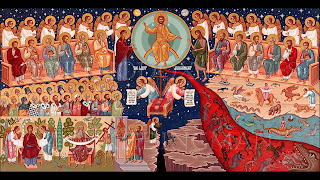
Last Judgment Sunday (Matthew 25:31-46)


St. Augustin describes how generous our Lord is in offering us eternal rewards in exchange for giving Him comparatively insignificant acts of kindness in the people of the poor, sick, and imprisoned.

He says, “And what have I received, and what do I repay? 'I was an hungred,' He says, 'and you gave Me meat;' and the rest. I received earth, I will give heaven; I received temporal things, I will restore eternal; I received bread, I will give life. Yea, we may even say thus, I have received bread, I will give Bread; I have received drink, I will give Drink; I have received houseroom, I will give a House; I was visited in sickness, I will give Health; I was visited in prison, I will give Liberty. The bread which you gave to My poor is consumed; the Bread which I will give both recruits the failing and does not fail. May He then give us Bread, He who is the living Bread which came down from heaven. When He shall give Bread, He will give Himself. For what did you intend when you lent on usury? To give money, and to receive money; but to give a smaller sum, and to receive a larger. I, says God, will give you an exchange for the better for all that you have given Me. For if you were to give a pound of silver, and to receive a pound of gold, with how great joy would you be possessed? Examine and question avarice. I have given a pound of silver; I receive a pound of gold! What proportion is there between silver and gold! Much more then, what proportion is there between earth and heaven! And your silver and gold you were to leave here below; whereas you will not abide yourself for ever here. And I will give you something else, and I will give you something more, and I will give you something better; I will give you even that which will last forever. So then, Brethren, be our avarice restrained, that another, which is holy, may be enkindled. Evil altogether is her counsel, who hinders you from doing good. You are willing to serve an evil mistress, not owning a Good Lord. And sometimes two mistresses occupy the heart, and tear the slave asunder who deserves to be in slavery to such a double yoke. Yes, sometimes two opposing mistresses have possession of a man, avarice and luxuriousness. Avarice says, ‘Keep;’ luxuriousness, says, ‘Spend.’ Under two mistresses bidding and exacting diverse things what can you do?”

He then warns about how these two sins hinder us from trusting in our Lord and receiving heavenly rewards for earthly deposits.

Avarice tells us to “keep for yourself, consult for the future.” When we look at examples of people that have tried to preserve their wealth until a good old age or as a possession to pass on to their children, we see how most times things do not go as planned due to unexpected misfortunes or ungrateful children that are not benefited from such inheritances.

Our Lord wisely offers the same counsel as Avarice that we should “keep for ourselves and consult for our future.” We must keep for ourselves treasures in Heaven and consult for our future by preparing for eternity by being worthy of entering into the Kingdom of Heaven.

Luxuriousness tells us, “Do well to thine own soul, spend as freely as you can.” Our Lord shared the accounts of the rich man that spurned the beggar Lazarus and the rich man that wanted to build larger barns to show us the results of those that chose to only do well to their own souls. Both men had terrible ends in torments, both men having had their rewards in their earthly lives.

Our Lord once again uses the same words, but with different meaning saying, “Do well to thine own soul, spend as freely as you can” We do so by almsgiving, knowing that our reward will be in the Heavens that will last for eternity.

We are blessed to live in a time after our Lord’s Resurrection and after so many Saints of the Church to have been instructed and given Grace to do God’s will.

Unfortunately, our Lord has prophesied that even with these great advantages, evil will one day reach a height that people will worship and obey the Antichrist. This will bring about the second coming of Christ when He will come with great power to “cut off the incurable from the healthy like rotting limbs and deliver them into the fire, but His own He will rescue from the spiteful abuse of evil men and from contact with them, and will make them heirs of the kingdom of Heaven.” (Gregory Palamas)

So let us not be afraid to give of ourselves in fear of becoming poor, for we will hear Christ say to us, “Come, ye blessed of my Father, inherit the kingdom.” Rather let us be afraid of not showing love to God by our lack of compassion and hear the dreadful sentence of condemnation.

If we focus on what rich blessings our patient, loving Lord gives us in exchange for such small temporary acts of love, we will be strengthened and inspired to “attain this by the grace and love for mankind of our Lord Jesus Christ, to whom, together with the Father and the Holy Spirit, be honor and glory unto the ages of ages. Amen.” (Gregory Palamas)


Sunday, February 6, 2022

Zacchaeus Sunday (Luke 19:1-10)


And Jesus entered and passed through Jericho. And, behold, there was a man named Zacchaeus, which was the chief among the publicans, and he was rich. And he sought to see Jesus who he was; and could not for the press, because he was little of stature. And he ran before, and climbed up into a sycamore tree to see him: for he was to pass that way. And when Jesus came to the place, he looked up, and saw him, and said unto him, Zacchaeus, make haste, and come down; for today I must abide at thy house. And he made haste, and came down, and received him joyfully. And when they saw it, they all murmured, saying, that he was gone to be guest with a man that is a sinner. And Zacchaeus stood, and said unto the Lord: Behold, Lord, the half of my goods I give to the poor; and if I have taken anything from any man by false accusation, I restore him fourfold. And Jesus said unto him, this day is salvation come to this house, forsomuch as he also is a son of Abraham. For the Son of man is come to seek and to save that which was lost.

Last week we read of the healing of the blind man Bartimaeus, where our Lord rewarded the persistence of the blind man who continued to cry out to Jesus for mercy as the crowds tried to silence him. We can personally apply the events to ourselves as we too are blind spiritually, and when our Lord passes us by in His loving grace that He bestows on each person in His own way, desiring that all be saved, our remembrances of past wickedness try to silence our cry for our Lord to visit and heal us. If we persist in prayer God will call us unto Himself and heal us.

Today we read of the account of Zacchaeus and learn another way in which we all suffer spiritually but are able to be healed by our all-mighty God. We see that Zacchaeus was chief among the tax-collectors, of whom we know were of the most greedy and cold-hearted people of the day, making their fortune on taxing the poor unfairly.

We do likewise spiritually, using others primarily for selfish reasons and always looking for our own comfort with little regard for others. We share in the sins of our forefathers who greedily desired to be like God, ungrateful for all the gifts of God. We sell our birthright of being made in the image and likeness of God by not fearing God and his commandments, but rather committing gross sin for our own fleshly benefit. Our God-given conscience informs us that we are truly chief among sinners, as we admit in our prayers that we recite before partaking of the precious Body and Blood of our Lord.

But as our Lord wanted to demonstrate that no one is beyond forgiveness, and rescued Zacchaeus from the hold of Satan, we can have hope that our sins are not beyond forgiveness and that our Lord is willing to abide in us even though we have defiled ourselves and are not worthy for Him to enter into the temple of our bodies.

As our Lord was passing through Jericho, Zacchaeus, having heard of the miracles that Christ had performed, desired to see Him, indicating Zacchaeus’ unhappiness with the lifestyle of chief tax-collector. Using the gifts of conscience and the Mosaic Law, Zacchaeus was able to begin the process of repentance and climb up off of the earth and begin to ascend toward holier things, realizing that earthly and fleshly passions and sins were not allowing him to see our Lord.

Our Lord has lovingly given us all what is necessary to begin the journey toward salvation, but as is being taught in this account, it is Christ who comes to us to save us, as we are not capable of ascending into Heaven ourselves, even if we have begun to leave the cares of the world and climbed up toward a holier way of life.

Our Lord then tells Zacchaeus to quickly come down from the tree so that He could visit Zacchaeus in his home. The Gospel that our Lord taught and that the Church continues to teach is the Cross of Jesus Christ. The Word of God came down from Heaven and took the form of a slave by becoming the God-Man. Fulfilling all that God commanded of man and conquering death in Himself by voluntarily dying on the Cross and rising on the third day because death had no right to claim Him, for He had no sin. He then offered to us all a sharing in His victory, by Baptism into His death so that we could also share in His Resurrection. But just as He perfectly modeled humility and love for God and man, we are commanded to be perfect as well, which for us means dying to the old man and renewing our mind. Only then can we share in our Lord’s death, which perfectly modeled all the virtues of holiness.

So, as we begin our journey toward holiness by climbing the spiritual sycamore tree, our Lord meets us and offers us to descend into the earth with Him, calling us to humble ourselves and to die to our old way of life, by being baptized. Our Lord then longs to enter into our homes and dine with us. He offers us His Body and Blood in the Holy Mystery of the Eucharist.

After our Lord visited Zacchaeus in his home, he was moved to perform works worthy of repentance. This close encounter with our Lord gave him the ability to perfectly sacrifice everything in imitation of our Lord who sacrificed everything for us. He gave half of his money to the poor and paid back those that he had cheated fourfold with the rest of his money, leaving practically nothing for himself.

We see though that everyone that witnessed this visitation of our Lord to Zacchaeus was scandalized that Jesus would enter into the home of such a great sinner. This is a warning to us all that we must first of all never forget that we are the chief of sinners ourselves and not to judge others as sinners unworthy of Christ’s visitation. Secondly, it can teach us that no sin is too great for our Lord to heal and therefore we must look at each person we encounter with the hope that they will rise above their sinfulness and allow the Lord to invite them to die with Him to rise with Him and to enter into their home and become a member of the Holy Body of Christ.

Our Lord speaks of the communion of the Saints by calling Zacchaeus a son of Abraham. Abraham left everything behind and journeyed through the wilderness when God called him to do so. He also was willing to offer his only beloved son as a sacrifice when God instructed him to do so. Similarly, when we sacrifice everything to God and follow his commands, we are united with Abraham and all the other Saints and Angels who also sacrificed everything for our Lord’s sake.

Our Lord clearly states that He has come to seek and to save those that are lost. Only those that listen to the gentle counsels of God and begin the journey to rediscover the image and likeness of God that we have buried under layers of earthliness, can say that they are lost in this world, and that their real home is in the Heavens. Those that love sin and darkness cannot be said to be lost, because they are at home in this fallen world.

As we draw close to the great fast, let us remember our baptismal promises and plan to enter into the fast with a renewed zeal like little Zacchaeus, running and climbing up the sycamore tree, knowing that our Lord will come and strengthen us to descend with Him and sacrifice ourselves even more. Then we will have a joyous Pascha and will feel closer to our Lord, to the Holy Theotokos, and all the Angels and Saints. Amen.


Sunday, January 30, 2022

The healing of the blind man (Luke 18:35-43)


And it came to pass, that as he was come nigh unto Jericho, a certain blind man sat by the way side begging: And hearing the multitude pass by, he asked what it meant. And they told him, that Jesus of Nazareth passeth by. And he cried, saying, Jesus, thou son of David, have mercy on me. And they which went before rebuked him, that he should hold his peace: but he cried so much the more, thou son of David, have mercy on me. And Jesus stood, and commanded him to be brought unto him: and when he was come near, he asked him, Saying, what wilt thou that I shall do unto thee? And he said, Lord, that I may receive my sight. And Jesus said unto him, receive thy sight: thy faith hath saved thee. And immediately he received his sight, and followed him, glorifying God: and all the people, when they saw it, gave praise unto God.

Why does God allow people to be born blind? How can the person born blind deserve to be deprived of his sight if he has not yet committed any sin worthy of punishment? We may be tempted to accuse God of a great injustice especially if this type of ailment affects someone close to us, like a child. But we must remember that temporary physical blindness is but a second of unpleasantness in the potential eternal blessedness of the glory of Communion with God in Heaven. It is just how as tasting a bitter medicine for a moment causes us agony, but heals us of a serious ailment.

Our Lord only allows physical blindness in this fallen world to be a symbol of the spiritual blindness that all mankind possesses to some degree. When our first parents sinned against God they were driven away from the light and suffered the darkness of condemnation.

But as we hear in today’s Gospel reading, our Lord Jesus Christ drew near to the city of Jericho. Jericho is interpreted as ‘moon’, and so we can understand this event to be describing the condescension of our Lord in assuming a human body to recover the light that it had lost, as the moon depicts the weakness of our mortal nature by waning in its monthly changes. As our Lord suffered as a human, humans are raised up to divinity.

As we hear the blind man call out to Christ to have mercy on him, we see that those that went before Christ told the blind man to be quiet. We understand this event to symbolize the spiritually blind longing for the light of truth, but as they cry to the Lord the crowds of bodily desires and the uproar caused by our vices try to silence or prayer to God.

As we pray to God to come and deliver us from darkness and lead us into light, images of our sins come into our hearts and obscure our inner vision, sometimes rising up in our thoughts as images to throw us into confusion in the very act of praying.

We are being instructed to imitate the blind man when such assailments come our way, and to cry out even more fervently to our Lord to have mercy on us since we are weak and unable to fight against the crowds of temptations that remind us of our sins. Even if we are remorseful for our sins, the sorrows of repentance hardly drive away the images of past sins.

Then we hear that our Lord stopped and ordered the blind man to be brought to Him. The two natures of Christ are emphasized here. In our Lords humanity which can be described as changing and moving, our Lord has become close to us and attracted us towards Himself. Once this has occurred, our Lord calls us to Himself as He stands still in His Divinity and gives us His Light that heals us from our blindness.

When Christ called the blind man to Himself, He asked him what he wanted, and the blind man requested only that he would be given his sight. We must imitate him and not ask for deceptive riches or earthly gifts or passing honors, but only for Light.

Then after healing the blind man, our Lord credits the man’s faith in his being healed of his blindness, emphasizing our part in responding to our Lords grace with our free will. He is not ashamed to give all the credit to the blind man although it is in reality only by His great mercy that the blind man even had the opportunity to be healed. Our Lord loves all mankind and desires that all be saved and offers great mercy to all. Only some respond to this call with the desire to receive spiritual sight and that is why our Lord credits those that faithfully beg our Lord for sight for being healed by their faith.

Then the man who was previously blind follows after our Lord. This means nothing else than imitating our Lord who left an example of how to live. “He refused to prosper in this world; he endured reproaches and mockery, he bore up under spitting, scourging, blows, a crown of thorns and a cross. Because we had fallen away from inner joy by our delight in material things, He showed with what bitterness we must return to it.”-Gregory the Great

And as this man was healed by his repentance and perseverance and by imitating Christ, others gave glory to God and also entered into the process of being healed of spiritual blindness. May we continue on our path in seeking God’s Light, healing us of all darkness by our constant prayer to our Lord, His most pure Mother, the Bodiless Hosts, and all the Saints. Then we too may attract others to abandon the darkness and draw close to God and be healed. Amen.