Sunday, July 5, 2020

The Great Faith of the Centurion - Matthew 8:5-13


The Great Faith of the Centurion - Matthew 8:5-13

    How was it possible for a Gentile to have such great faith so as to believe that Jesus could heal his servant with a mere command? How did he, as an idolater, have such humility to recognize his unworthiness before Christ, not even wanting Him to enter into his house?

    It is marvelous to ponder on the fact that our Lord publicly recognized the centurion's faith while He criticized the general lack of faith found among the Jews. Even the Lord's closest friends did not exhibit such faith as the centurion. Two of our Lord’s closest friends, Martha and Mary, exhibited some of the greatest faith in Jesus’s ability to heal the sick. They believed that the presence of the Lord would have prevented the death of Lazarus. But this centurion had faith that at the words of our Lord, his servant would be healed.

    St. Nikolai Velimirovich says, "for when God works one work, He does it in such a way that His action is not just of service in one area, but in many. Christ desired that this event should be of help to many: to heal the sick, to reveal the centurion's great faith, to reprimand the Jews for their unbelief and to give expression to a great prophecy about the Kingdom... What a vast difference between this burning faith and the cold legalistic beliefs of the Pharisees. When one of the Pharisees invited Christ to his house for supper, he thought, in his legalistic arrogance, that he was doing the Lord honor by inviting Him into his house, and not that the Lord was honoring him and his house by entering under his roof. In his arrogance and overweening pride, the Pharisee neglected even the customary expression of hospitality: he neither brought his guest water to wash His feet nor greeted Him with an embrace, nor anointed His head with perfumed oils."

    St. Nikolai explains how it is that he was able to have such faith saying, "See how humble and repentant this 'pagan', to whom it was not given to know Moses and the prophets, and who had his natural mind as the one light for the distinguishing of truth and falsehood, good and evil, was before the Lord."

    "To peoples who had moved far from God's primal revelation, God left nature and the mind: nature as a book and the mind as a guide to the reading of this book. To Christians, though, in addition to nature and the mind, God's primal revelation has been restored, and a new revelation of truth has been given in the Lord Jesus Christ. As well as this, Christians have the Church, that is the guardian, interpreter and guide in both Revelations; and finally, Christians have the power of the Holy Spirit, who has given life from the Church's beginning, and teaches and guides it." (St. Nikolai)

    Bishop Augoustinos Kantiotes relates this powerful illustration that distinguishes the difference between those that claim to represent Him and those that while not official representatives of His, learn to practice virtue, saying, "Let us put forth an example. Someone was given a thousand gold coins. Instead of using this amount of money well, the sluggard and lazy recipient of the money buried it deep in the earth. Someone else was given only a thousand drachmas. This man was a hard worker, diligent and energetic. He increased his investment and produced results. The great treasure of immeasurable value is the Christian faith. Most Christians are not interested and do not use it as they should. They are indolent and lazy, indifferent and of little faith, or unbelievers and atheists who bear only the name of Christian and nothing more. While you see those of other faiths and creeds, who from tradition or conscience, cultivate increase, and multiply, bringing forth virtues that are admirable. The so-called Christians are engaging in scandalous deeds and ugly crimes. These pseudo-Christians are slandering and blaspheming the most beautiful religion in the world."

    We saw a great lack of faith recently when many Churches closed out of fear of disease. Instead of running to Christ in His Life-giving Mysteries (both physical and spiritual life), we saw that physical life free from suffering was prioritized.

    We were shamed much like the Jews in the account when many of other faiths were willing to be put in jail rather than close the doors to their churches; churches where the Mysteries of Christ are not even present.

    Instead of asking our Lord to not enter into our house because of our unworthiness out of humility, we demanded that He not do so out of fear of bodily death and with no concern for spiritual life. We effectively told Him that He was not worthy to enter into our bodies because He could transmit disease to our flesh, which we have made idols of.

    St. Gregory Palamas asks, "Who are those children of the kingdom expelled into darkness? Those who confess the faith, but deny God with their works, 'being abominable, and disobedient, and unto every good work reprobate'(Titus 1:16). Who are those who sit down with Abraham, Isaac, and Jacob in the heavenly kingdom? Those who, with sincere faith, order their lives according to the law and the teaching of the Spirit, and demonstrate their faith through their works."

    St. John Chrysostom tells of God's Love for all mankind saying, "He profits us by opening His discourses about His kingdom and drawing all men towards it. For those even whom He was threatening to cast out, He threatened not in order to cast them out, but in order that through such fear, He might draw them into it by His words."

    We can also learn a great lesson in how to approach God in prayer by the words of the Centurion. We notice that the Centurion only laid the concern before the Lord, fearful of even asking for his servant's healing because of his unworthiness, but with full faith that He could do so if He so willed.

    Similarly, we should lay our concerns before the Lord, trusting that God's will be done; whether He takes away a painful situation or not. We know that He is the great Physician and will apply the proper remedy to any given ailment.

    We recognize like the Centurion the mastery that Jesus Christ has over all things. He is able to overcome and command death just as a master commands a slave. For in saying, 'come, and he cometh,' and 'go, and he goeth; he shows that if He should command his end not to come upon him, it will not come.

    St. Gregory the Theologian comments on our need to approach God with humility especially mindful of our sinfulness saying, "Let each one of us also speak so, as long as he is still uncleansed, and is a Centurion still, commanding many in wickedness, and serving in the army of Caesar, the World-ruler of those who are being dragged down; 'I am not worthy that thou shouldest come under my roof.'"

    Our Lord showed that the Centurion was indeed worthy to have Him enter into his house and did much greater things, marveling at him, and proclaiming him, and giving more than he had asked. For he came indeed seeking for his servant health of body, but went away, having received a kingdom. We see how the saying had been already fulfilled, 'Seek ye the kingdom of heaven, and all these things shall be added unto you.' For, because he showed great faith, and lowliness of mind, He both gave him heaven, and added unto him health.

    May we strive to attain such faith and humility as the centurion, and be counted worthy as vessels of our Lord and God. To whom be Glory now and ever and unto the ages of ages. Amen.


Tuesday, March 3, 2020

Cheesefast Sunday


In his homily for the Gospel reading for Cheesefast Sunday, Matthew 6:14-21, St. Nikolai Velimirovich shares the fact that, "The Lord does not order us, with the power of authority: forgive men their sins! He leaves it to our free choice, to forgive or not. He will not violate our freedom, to force us to do something, for then our action would not be ours but His, and it would not have the value that it would have if we did it freely and willingly." He is explaining the Orthodox understanding of synergy in which we have our part to do even if God has made all things possible, even the ability to forgive. In our day to day lives we know that we have the choice to forgive or not, but when it comes to interpreting Holy Scripture for some reason, many have bought into the misunderstanding of believing that we are only able to do good deeds, such as forgiving, if God not only give us the grace to forgive, but also gives us the grace to think about forgiving in the first place. And this is in a way that God chooses, apart from anything on our part. While Holy Fathers like St. Nikolai might not get too deep into the specifics of how God's grace is working specifically each time we do good deeds, it is very clear that he believes it is heretical to think that God could violate our freedom and force us to forgive others. And so while we credit God for continually giving us of His Grace, and that we could do nothing, especially good deeds, without His Grace, we must acknowledge that we have our part to do as well, no matter how significant it may be in comparison to what God does. If we would like to think of it as God doing 99.99% and us doing 0.01%, that is helpful in understanding God's great power and immense love for mankind. But when we want to look at our responsibilities as creations made in the image and likeness of God that have been made members of the Body of Christ through Baptism, that 0.01% is everything. It is the part that will decide whether we enter into the Kingdom of God or cast into Hell with Satan and the demons. As far as we are concerned, it is a very important 0.01%.

Continuing with the next part of the verse, St. Nikolai makes the point that God points out what will happen if we do not forgive others their trespasses, that God will not forgive us our trespasses. And then he explains, "where shall we be? We shall live out our days under a mountain of sin, and in the next life the weight of that mountain will grow ever greater through all eternity." What a terrifying thought that explains the torments of Hell, the ever increasing weight of our sins crushing us because of our guilt. With so much warning and patience from God, we will have no excuse at the end of our life for not repenting of our sins and practicing forgiving others that offend us.

On a passage about fasting it is interesting that the lesson begins with a lesson on forgiveness and concludes with a lesson on riches. There is a close link between the three as St. Nikolai points out, "For when fasting is understood in a true, Christian sense and not in a legalistic Pharisaical way, then the forgiving of insults and abstaining from covetousness are a fast, and this the most important fast, or, if you wish, the greatest fruit of fasting. For indeed, there is very little value in abstaining from food without abstinence from the returning of insult for insult and the illusion of eartly riches." He makes an insightful spiritual understanding of the admonition to "Anoint thine head" while we fast, saying, "anoint your mind with the Holy Spirit. For 'the head' signifies 'the mind' and the whole soul, and the fragrant oil with which the head is anointed signifies the Holy Spirit. And this means: fast from all evil thoughts, and keep yourself from all obscene and unnecessary words." And like how we enjoy the feeling of anointing and washing of our body, fasting should give pleasure and joy to our soul. We must first make fasting our own in our mind, heart, and will, and then fulfill it willingly and joyfully in our body. May we begin this Lent with a proper fear of transgressing God's commandments and a determination to fast from all things dangerous for us in our spiritual journey and to imitate our perfect God as often as possible.


Wednesday, February 19, 2020

A reflection on Genesis 3:21-24


Also for Adam and his wife the Lord God made garments of skin, and clothed them. Then the Lord God said, 'Behold, the man has become like one of Us, to know good and evil. Now, lest he put out his hand and take also of the tree of life, and eat, and live forever--' therefore the Lord God sent him out of the garden of pleasure to cultivate the ground from which he was taken. So He cast out Adam, and made him dwell opposite the garden of pleasure. He then stationed the cherubim and the fiery sword which turns every way to guard the way to the tree of life. (Gen 3:21-24)

Many pious Christians have wondered, "why would God withhold the Tree of Life from mankind and allow us to experience death? Wouldn't it be more loving to allow us to correct our sins without having to experience death?" It is interesting that God seems to be in a hurry to put man outside of the Garden to make sure that he does not eat of the Tree of Life. At first glance, this passage seems to be a straightforward story of a severe punishment for a serious offence. We call to mind Hebrews 12:6 that says, "For whom the Lord loveth he chasteneth, and scourgeth every son whom he receiveth." But we must ask, "how is it loving, that God has kept us away from the Tree of Life?" It is difficult for us to see love when we experience the death of our loved ones today.

We must think of the consequences that the alternative action, of allowing man to eat of the Tree of Life, would have had. The Fathers of the Church teach that man would have gone on sinning forever, never becoming what God had purposed for him. Our view of life in this fallen world is critical in how we understand God's actions recorded in our passage of Scripture. Do we see this life as all there is? Do we think of eternal life in Heaven with God and the Saints and Angels? Do we trust that God hates death more than we do? Do we trust that God is doing everything in the wisest and most loving way possible, working to bring about our salvation?

With a proper view of God's will and eternity, we can see why God swiftly took action to keep us from further harming ourselves. We can see that He lovingly gave us garments of skin as a reminder of our mortality and fall from an angelic way of life, where we were once clothed with a heavenly garment. We chose to leave God spiritually. And in His wisdom, God has allowed us to experience life separated from Him to a degree, not totally, because our God is not far off from us as Scripture says. It is in this period of life outside of God's garden, that we must learn repentance, humility, and all other virtues characteristic of citizens of heaven.

We can all relate to a familiar story where an older son, who still lives at home, begins to live a sinful life that is harmful to himself and his family. After refusing loving guidance to correct his life, the father is forced to kick the son out of the house. The father caringly provides the son with essential goods to be able to make it on his own. He even checks in on him once and a while, to see how he is doing and to provide him with more essential items when he sees fit. We see that the father wills the best for his son, but because of his harmful sins, must allow him to taste the bitterness of life outside the loving family, where he will not meet anyone that loves him the way that his father does. In his immaturity, the son needs to learn the hard way, that life in sin, out on your own, is the most cruel and depressing state to be. The son had two choices while living at his father's house, whether to obey his father's commands put away sin, or to continue in his harmful way of life. Out on his own, he has two choices before him again, whether to look at his dire condition, recognize the error of his ways, and return to his caring father in repentance or to be angry with his father for his casting him out and to stay in his miserable station in life.

We all have the same choice right now. Will we be angry at God forever for allowing us to experience suffering and death, which when we come to understand it, was our own creation or will we acknowledge the error of our ways, see God's love in allowing us to experience suffering and death as a means to cleanse us of all sin and return to God with repentance.

Let it be our aim to put away the garments of skin, the fleshly thoughts of the old man, and put on the uncorrupted garments of virtue of the new man created according to God. Let us return to the garden, no longer having the serpent as our guide, but only the loving commandments of God. Let us cast aside the taste for evil and partake only of the pure and unmixed good which has no share in iniquity. Only then will we be worthy to partake of the Tree of Life that has come down from heaven, present in Orthodox Churches around the world, the Holy Mysteries of our Lord's Body and Blood in Holy Communion. Amen.

Thursday, February 13, 2020

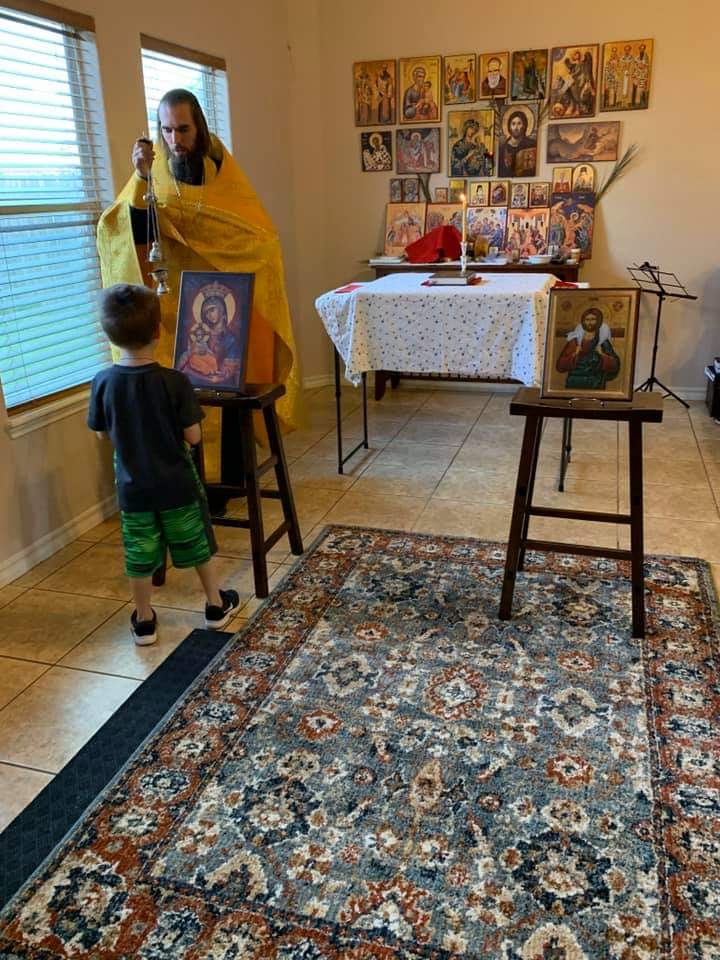
Photos from Divine Services on February 8 and 9, 2020


We are very grateful to Fr. David and his family for visiting us this past weekend. For our first Divine Liturgy, we were very happy that we were able to put some things together to celebrate the awesome Mysteries in a decent manner. It was an occasion that will be forever remembered as my two Orthodox cousins and their families were able to come and share in the experience of the first of what we hope will be many Divine Services. If you were not able to come, hopefully the photos will encourage you to visit next time Fr. David comes again. It truly was like a spiritual retreat to be with our friends and family celebrating the Holy Mysteries and fellowshipping. 


Sunday, June 2, 2019

The Miraculous Healing of the Man Born Blind (John 9:1-38)


After learning from the healing of the paralytic that God allows us to suffer affliction because of our sins, naturally, the apostles wondered if someone's sin was responsible for this man being born blind. It is not impossible that it could have been a punishment on the parents because many times God allows children to be afflicted with physical ailments to help teach an important truth that deals with our soul but is demonstrated in the flesh. But in this case of the man born blind, we are told by the Lord that it was not because of the sins of his parents that had brought it about, but rather so that the works of God should be made manifest. The Lord and Creator of man, Jesus Christ purposely withheld the creation of the eyes of the man at birth to later create them as indicated in the Gospel reading to help us to identify Who it was that came to us for our salvation; the Creator Himself.

But some might say that it was unjust to deprive this man of his sight so that the works of God should be made manifest in him and that He could have used some other method, but the man was not treated unjustly. For although he was deprived of material light for a time, he was given the enlightenment of the eyes of his soul along with his physical sight. The man's physical blindness was of benefit to the man because by his healing he came to know the True Sun of Righteousness, while many others born with their physical sight proved to be blind in spirit to the Truth and suffered greatly for their material vision. This event benefits all of mankind because by it we are confident that it was God Himself that came down from Heaven and became man. He comes to the man in this account without the man seeking Him or requiring any faith in Him as He did in other instances to further prove His divinity.

The Lord spoke many spiritual truths in the presence of the blind man before He healed him so that the blind man could hear His words and be healed of his spiritual blindness first, as his spiritual sight was of far more value than his physical sight. To heal man's spiritual blindness is far more difficult than to heal man's physical blindness, and far more important. To demonstrate the ease of healing physical blindness and to show that physical sight is nothing in comparison to spiritual sight, the Lord spat on the ground, made clay of the spittle and smeared it on the blind man's eyes, showing that physical sight could be given by scorned spittle and dust. The man’s spiritual sight however would take more effort to restore, and would need to be tested by trial, just like gold being refined in the furnace. He would have to pass the test of obedience and show himself to be meek when the Lord sent him with clay-smeared eyes to wash in the pool of Siloam. He then would have to pass the test of perseverance under persecution and temptation when the Pharisees tried to make him deny Christ even though they had the power to put him to death. To show God's great love for us, we see our Lord coming to the blind man immediately after he passed these tests to console him and to grant him a crown of victory. The Lord confronted him with a third and final test, the greatest test, that of true faith. He asks him, "Dost thou believe on the Son of God?" The Lord bestowed upon him knowledge and a more exact faith, and the healed man fell prostrate and worshiped Christ, Who appeared as a lowly man but is also the Son of God.

St. Theophylact also reminds us of the universal message of the story; "Understand also the spiritual meaning of this miracle. Every man is blind from birth, as a result of being brought into existence by coition, and being yoked thereby to corruption. From the moment we were punished with mortality and our race was condemned to increase by a passionate means of conception, a thick cloud covered our noetic eyes, like a cloak of flesh, as the Scriptures say." We are all in a way born incomplete because of our connection to our first parents that lost their spiritual vision. We are all one organism, fellow members of each other, not separate entities, completely cut off from one another. In God's Providence, He makes our physical weakness a means to help us to see spiritually. We are able to grow in humility, seeing the death and darkness that accompany withdrawal from God, the source of Light and Life. May we learn the valuable lessons from this miracle and receive spiritual sight from our loving God Who lowered Himself and came down to us in our blindness to raise us up to His Heavenly Kingdom, where he gives beggars the power to confess Christ boldly and to rebuke the high and mighty of the Earth. Amen.


Monday, May 27, 2019

The Giver of Living Water and the Samaritan Woman


    Our Lord in His great Providence made possible a conversation with a woman from Samaria from which we learn very great lessons. Although He came to the children of Israel, He took advantage of their rejection to demonstrate that Faith and Obedience were indications of being true descendants of Abraham, not merely being born from him physically. Creating the opportunity, our Lord was able to be left alone to have a conversation with this Samaritan woman about the Gift of God of Living Water that is able to quench our Spiritual thirst. As the psalmist said, "My soul is athirst for God; yea, even for the Living God!" Only God is able to quench our soul's thirst because our soul is not made of the earth like our bodies are. We try to capture Life by pursuing all types of worldly pursuits, but are never able to, and are constantly hoping that one day we will find Life in an unexpected source.

    The Samaritan woman asks our Lord, "Art thou greater than our father Jacob, which gave us this well, and drank thereof himself, and his children, and his cattle?" She was expressing the physical wonders of the well which was able to provide water for Jacob and his children and cattle, but our Lord desired to provide her with a spiritual lesson from God's great and marvelous creation. Just as how this well was able to quench the thirst of all of Jacob’s family, down to even his cattle, the Source and Maker of all creation is able to quench the Spiritual thirst of the man of God, down to his children, his thoughts, and his cattle, the powers of his soul that are not endowed with reason such as anger and desire. The water bringing physical refreshment, is symbolic of the spiritual waters of purification in Holy Baptism and in the hot tears of repentance that bring one over from a life of wickedness to one of blessedness.

    "Jesus saith unto her: 'Go, call thy husband and come hither.' The woman answered and said: 'I have no husband.' Jesus said unto her: 'Thou hast well said: 'I have no husband', for thou hast had five husbands, and he whom thou now hast is not thy husband; in that saidest thou truly." How quick we are to judge this woman for being on her 6th partner, thinking to ourselves, “no matter how bad I may be, at least I haven’t been married and divorced 5 times and still living in sinful relationship”. Spiritually, all Christians are only to be wedded to one person and that is Christ. Are we able to confidently say that we have not had 5 husbands already? Can we surely say that the current partner we have is Christ and not someone else? We are addicted to this sensual world, and give over our 5 senses to it and find ourselves in the same state as the Samaritan woman. Having been let down with finding any lasting happiness in the 5 senses, we have divorced them, and have gone to live with our sixth partner, the successor of the 5 senses, Falsehood and Filth. We have become fornicators with Heresy, erring grievously in doctrine. But now that Christ has come and offered us Living Water, we have the choice of asking Him to stay with us as did the Samaritans, or we can be like the Nazarenes that sought to cast the Lord down from the hill to destruction for His words, or like the Gadarenes who begged Him to leave them and go away.

    The Lord is asking this most important question of us: who is it that we are wedded to? We can answer that we are wedded to the world, sin, or the Devil, and be destroyed along with them. We will be drinking a water that will only make us thirstier the more we drink from it. Or we can acknowledge Christ the Lord as our lawful Husband, and espouse ourselves to Him with faith and love, and drink of His living water, from which we will not thirst and on which we will float into the heavenly Kingdom and Eternal Life.

Friday, May 10, 2019

Ephrem the Syrian on Salvation


I've been reading through St. Ephrem the Syrian's homily "On our Lord" found in His collection of "Selected Prose Works", published by CUA and thought I would share a few of the beautiful thoughts of this God Bearing Father.  His words are very inspiring and bring a refreshing feeling to the soul after reading them.  I am amazed at His ability to explain the whole of Salvation and the Christian way of Life from short accounts in the Gospels such as the account of the Sinful Woman and the Pharisee recorded in the 7th Chapter of St. Luke's Gospel.  Here are a few quotes from St. Ephrem in His homily "On our Lord".

In speaking of God's great condescension and ultimate Justice for the righteous, he says the following: "The Only-Begotten journeyed from the Godhead and resided in a virgin, so that through physical birth the Only-Begotten would become a brother to many.  And he journeyed from Sheol and resided in the Kingdom, to tread a path from Sheol, which cheats everyone, to the kingdom, which rewards everyone.  For our Lord gave His resurrection as a guarantee to mortals that He would lead them out of Sheol, which takes the departed without discrimination, to the kingdom, which welcomes guests with discrimination, so that we might journey from where everyone's bodies are treated the same, to where everyone's efforts are treated with discrimination."  Like St. Gregory of Nyssa, He teaches that our Loving Lord came down to rescue us and our brothers lying in death from the inescapable prison of sin and death that rightfully contained all of mankind.  He also teaches the same imagery that St. Gregory of Nyssa used to describe the purpose of the Incarnation, namely that he took a body from the Most Holy Virgin in order to be able to be devoured by death and Sheol in order to break into its vaults and carry off its treasures.  "When death came confidently, as usual, to feed on mortal fruit, life, the killer of death, was lying in wait, so that when death swallowed life with no apprehension, it would vomit it out, and many others with it."  He speaks of Christ disguising Himself to be killed on the Cross, but supernatural Life killed death, thus with the very weapon that death had used to kill Him, He gained the victory over death.  This is why we as Orthodox Christians love the Cross, because it has become for us a great weapon and bridge to Heaven.  It is as if the Cross itself is used to tread this new path out of Sheol to the Kingdom of Heaven.  And in God's great Providence, He has allowed all of us to taste of death so that we could mature and become dispassionate especially in the area of Pride, which is what began our downfall in wanting to become our own gods at the tempting in the Garden.  So we as offspring of Adam and Eve are devoured by death without discrimination, from the Holy Patriarchs to the wicked Judas, but once brought out of Sheol, we will be rewarded for our Faith and good deeds or punished further for our obstinate vices in the face of God's great mercy and patience.

Continuing to contemplate on the ineffable condescension of the Incarnation St. Ephrem also says, "The Firstborn, who was begotten according to His nature, underwent yet another birth outside His nature, so that we too would understand that after our natural birth, we must undergo another birth outside our nature.  As a spiritual being, He was unable to become physical until the time of physical birth.  And so too physical beings, unless they undergo another birth, cannot become spiritual."  He teaches the great love that God has for us in showing us what it is we must do to enter into adoption as Spiritual children of God.  It is not enough for us to try to live in this world as if it is our only life, forsaking our future immortal life.  We must be born again or anew in the Spirit so as to enter into the God-Man Jesus Christ and share in Divine Life for all eternity.  We do this by dying to the old way of life and allowing God's Will to become our will, and not worrying over things of this life as if they were in any way permanent.  So our Loving Lord chose to be born as a baby to the Holy Virgin Mary to show us the need of being born again, if we are to share in both physical and Spiritual Life.

Then the Holy Father explains the Mystery behind the event of the sinful woman and Simon the Pharisee saying, "Our Lord was not hungry for the Pharisee's refreshments; He hungered for the tears of the sinful woman. Once He had been filled and refreshed by the tears He hungered for, He then chastised the one who had invited Him for food that perishes, in order to show that He had been invited not to nourish the body but to assist the mind. Nor was it as the Pharisee supposed, that our Lord mixed with eaters and drinkers for enjoyment, but rather to mix His teaching in the food of mortals as the Medicine of Life. For just as the evil one had given his bitter counsel to the house of Adam under the guise of food, the Good One gave His living counsel to the house of Adam under the guise of food."  We see such brilliance given by the Holy Spirit to our Beloved Father, St. Ephrem.  He uncovers the real motive for all that Christ does in His humbling act of the Incarnation.  We, living in the world, often become blinded to eternal realities and can only look at the decaying things of the world right in front of our eyes.  The Pharisee, who was supposed to be the most educated and pious Jew at that time, could only think about temporary, ever-changing, decaying things such as physical food.  He who had seen our Lord do all kinds of miracles such as healing the blind, deaf, and mute, couldn't believe that our Lord would allow a sinful woman to wash His feet with her tears of repentance if He knew what kind of woman she was.  He failed to be hospitable to the One that he had previously seen re-create eyes in one born without eyes, and even began to question whether or not our Lord was even a Prophet at all!  When we are filled with such attachment to worldly things, we quickly forget the miracles that we have personally seen and look rather foolish in questioning God's Providence.  We see that God wants from us tears more than anything.  He does not lower Himself to our level to eat of decaying bread, but rather to give us the medicine of Immortality in the Holy Mystery of the Eucharist and the other Holy Mysteries of the Holy Orthodox Church.  We partake of these Life-giving Mysteries with fear and trembling, Faith, and Love, only with many tears of repentance and longing for God's Will to be done in place of all the wickedness that we were once a proponent of.  We see the proper use of cunningness here as well as in His tricking death by death, by using the wicked one's own methods to destroy Satan, as the Holy Prophet David foretold in His Psalms by saying that they "shall fall into their own net."  We must become "wise as the serpents and guileless as the doves" as our Lord taught us, meaning that we too must use the world in a way to bring about great Spiritual progress as our Lord demonstrated in this account.  We can use things as food to mix in the Holy Medicine that is our Lord Jesus Christ.