Saturday, October 19, 2024
The Raising of the Widow’s Son at Nain (Luke 7:11-16)
In the first Gospel reading, we are confronted with a very sobering event. One of the most difficult things to deal with in this life is to have to bury a child. And to make it more challenging, this woman was on her way to bury her only child, and she had already buried her husband. Sometimes it feels that everything is falling down around us and we may wonder where God is. Even though we have Faith and Hope in the resurrection, it is still very hard to not be weighed down by the natural aversion to death and destruction.
But as we see in this Gospel account, our Lord is not ignorant of our troubles, but on the contrary, has perfectly timed His encounter with His creatures. In Jesus’ time on earth, it took a long time to travel, and the fact that He met the funeral procession on the way out of the city was no coincidence. This means that He was aware and allowed each of the seemingly tragic events that led to this encounter.
As the Fathers teach, it is only out of love that God punishes. Physical death, although appearing to be terrible and void of any good, in actuality brings an end to sin so that it might not be immortal.
This however does not make death a good thing, but merely makes it better than the alternative of having immortal sin. Our Lord plans to eliminate both sin and death, and He demonstrates this in raising the young man from the dead. This resurrection was just a foretaste of the great resurrection that will take place at the second coming of Christ. This young man was temporarily brought back to life in this fallen world, but was able to care for his mother and bring her happiness by sharing more time with her.
This is similar to the dilemma brought about when we bring children into this sinful world. On the one hand we want them to enjoy a long healthy life because we love them and don’t like to see them hurting, but on the other hand we long for them to attain entry into the Kingdom of Heaven knowing that a long peaceful life in this world is often times a threat to the eternal life in Heaven. We are at a loss and must simply trust that God knows best in dealing with His creation that He loves more than any human love that we can experience.
Although our Lord does not go around bringing many people back from the dead, He did so in these accounts in the Holy Scriptures and has done so through His Saints that have been recorded in the lives of the Saints so that we can be confident that He has the power and desire to bring back our loved ones from the dead and that every event in our lives is seen by Him and will be corrected in the end. He asks of us to believe without seeing for ourselves, knowing that this brings about a love for God that is impossible to develop if God simply satisfied our every desire.
To help us have faith in the resurrection, we must constantly recall the saving acts of our Lord, the Incarnation, death, resurrection, and ascension of Christ Jesus. Our Lord shows this in the Gospel reading by touching the coffin of the young boy. He not only spoke the words “arise” to the boy, but showed the power of the incarnation by also touching the coffin with His bodily hands.
And as touching a dead body in the Jewish Law made you unclean; our Lord shows us that He is the author of Life by touching the dead man and restoring Life.
And although we learn a great deal about our Lord’s compassion for the physically dead, by not only expressing words of encouragement, but performing deeds of love, we are taught about our Lord’s compassion for the spiritually dead.
Our Lord did and still does from time to time give the power to raise the dead to His servants, but He gives to all men the power to raise the spiritually dead. Daily, people are brought from death to life through the Bride of Christ, His Church. And this resurrection yields a greater result in that this life is eternal.
So as this mother shed tears for the loss of her son, we must shed tears for the death of our soul within, lamenting over our sins in repentance. Only thin will the Comforter approach us and bestow eternal life and consolation to us.
So let us never despair when trying times come about, but if we stay prepared by meditating on the Kingdom of Heaven, we will trust that our Lord is very near us and bringing about a greater resurrection, that of the soul. To whom be the Glory, honor, and worship together with the Father and the Holy Spirit, now and ever and unto the ages of ages. Amen.

Sunday, September 25, 2022
Looking Upon the Cross of Christ (Sunday before the Exaltation of the Precious and Life-giving Cross)

Today we have three Gospel readings because we are in between the feasts of the Nativity of the Mother of God and of the Exaltation of the Holy Cross. If we look closely at the three readings, we can see a common theme, Love and obedience to God.
When we look at our Lord on the Cross we are saddened because it was for our sins that our Lord shed His blood. But we are also happy because we know that by the Cross, Christ destroyed death and opened the gates to Heaven for mankind. We are also instructed of the only path to God’s Kingdom in this fallen sinful world. From the moment of our Lord’s birth until His Crucifixion, many men and demons desired the death of our Lord because they hated the Light that Christ shined in this dark sinful world. He did not fit in with this sinful world and therefore the world hated Him. However, He did not come here to stay in that state. He came to rescue those that longed for God and holiness and were tired of the filth and darkness of the sinful world.
He set the example for all that would follow. The only way to set aside this fallen world is to die to it, trusting that whatever sickness that has grown in the soul and body will be purged after death and resurrection into a cleansed world free from the stain of sin.
It is fitting that we should have the Cross as the method of death. Death on a cross was considered the most humiliating execution. To counteract the great sin of pride of our ancestors that longed to be equal to God, our Lord died in the humblest method possible. We must do likewise by picking up our cross and following Him.
In the gospel reading in John, we hear, “as Moses lifted up the serpent in the wilderness, even so must the Son of man be lifted up: That whosoever believeth in him should not perish, but have eternal life.” This is a reference to an event recorded in the book of Numbers when the Israelites were wandering in the desert after their exodus from Egypt. They once again were complaining about life in the wilderness and wished to be back in Egypt as slaves so that they could at least enjoy the tastier foods and have some comforts. They had no patience or appreciation for all that God had done for them and what He promised to give to them. They forgot about the infanticide that the Egyptians did to them and the hard brick laying that was forced on them. To punish them, He sent serpents to where they were that bit and killed many of them. This woke them up and they repented and begged Moses to pray to God to take the snakes away. God instructed Moses to make a bronze serpent and to raise it high on a pole so that anyone that was bitten by a snake could look upon the bronze serpent and be healed.
We Christians today are no different than the Israelites. After being delivered from the enslavement to sin, we many times complain about the seemingly austere life of a Christian. We long for the old days of pleasurable sin, forgetting the bitterness of sin. There is no lasting joy in a life without God, because at best it will end in death after about 80 years. Our conscience will torment us the whole time as well. Instead of longing for days of the past and complaining about the ascetic life, we should fill our time with holy endeavors such as spiritual reading, attending services, associating with other Christians, seeking for ways to share the Gospel to others in word and in deed, and any other work that Christ left for us to do. We should focus on what we have been delivered from and on the eternal reward of heavenly life in communion with God, the Angels, and of all the Saints. We should look to eternal things that do not wear out such as building relationships with those that God has put in our lives.
Just as how God provided the Israelites with the bronze serpent, God the Father sent His Son to heal us of our sins. He was lifted up on the Cross for the whole world to see. How is Christ similar to a serpent? “It is because He became one of us, who are evil by disposition, for he came ‘in the likeness of sinful flesh,’’ and ‘He was counted with the transgressors.’” (St. Cyril of Alexandria) But just as how the bronze serpent did not have poison in it, our Lord did not have sin in Him.
And although Christ came to save all mankind, not everyone bitten by the serpents of sin look upon Him as instructed. They would rather stay in the darkness with the poison of sin than to look at the brilliance of Christ. “To look at Him and the Cross means to render one’s whole life dead and crucified to the world, unmoved by evil. Truly it is as the prophet says: ‘They nail their own flesh with the fear of God.’ The nail would be the self-control that holds the flesh.” (St. Gregory of Nyssa)
It is important to note that God did not destroy the serpents, but only kept their bites from causing death. This means that even for those that look to the Cross, they will still have to battle against the lusts of the flesh. There will come a time when the serpents will be destroyed, but now is a time for training.
In the second Gospel reading, we hear of a lawyer testing our Lord to see if He would contradict or add to the law of Moses. He asks what is the greatest commandment. We are blessed to hear how all of the commandments are really summed up into two commandments, to love God and to love our neighbor, and that even these two are really combined into one commandment because one cannot truly be done without the other. We are reminded of our Lord asking Peter if he loved Him, and then asking him to feed His sheep, and of the inspection at our Lord’s second coming where He will either commend or condemn us for seeing Him hungry and feeding him or not in the people we encounter. All sins are a result of either not loving God or not loving our neighbor. Therefore, the serpents can also be seen as acts of hatred toward God and neighbor. This is made clear by the fact that the Israelites were complaining about God and Moses.
Finally, we heard about the Mother of God in the third Gospel reading. We understand why God chose her from the very beginning of creation to be the person through whom the Word would become Incarnate. St. Luke records our Lord saying of her, “blessed are they that hear the word of God, and keep it.” From infancy the Theotokos kept the commandments of God and was found to be full of Grace at the time of the Annunciation. And we know that at the time of our Lord’s Crucifixion, the most pure Mother stayed there with Him looking upon Him and the Cross, being crucified herself in the spirit as she saw her sinless Son crucified as criminal.
So, as we remember these two great feasts of the Nativity of the Theotokos and of the Exaltation of the Cross, may we imitate the Holy Mother of God in her keeping of God’s word and staying at the foot of the Cross that brings Life to the world. For our Lord Jesus Christ has become for us the tree of life, to Whom be the glory together with the Father and the Holy Spirit, now and ever, and unto the ages of ages, Amen.
Sunday, September 11, 2022
The Beheading of the Glorious Prophet, Forerunner, and Baptist John (Mark 6:14-30)

Today is a very sobering day. We remember the death of the greatest man born of woman, the holy and righteous John the forerunner and Baptist. It just so happens that we as a country remember this day because of the terrorist attack that killed almost 3,000 people. This latter event is a reminder that this world is not our lasting home, but rather a quickly changing, uncertain, and temporary place that God uses to train and mold us into the Sons of God that He has willed from the beginning of creation. We can also connect the events in the sense that just as on this day that the Church remembers the egregious murder of Saint John the Baptist, who represented God’s law and prophets, who was the voice of God and prepared the way for Christ, the fact that our country is infested with sin and kills the voice of God, God lovingly gave us a wake-up call to remember our sins and to repent. Many did repent and go back to Church and started living better lives, but sadly this did not last.
It is very interesting that the sins that led to the death of John the Baptist were sexual sins. First, St. John was imprisoned for boldly condemning Herod for marrying his brother’s wife. This was adultery, which Gregory Palamas calls the most shameful of sins. Then when Herodias’s daughter lewdly danced at a party for Herod, he was so drunk with lust that he gave way to the beheading of the Holy Forerunner of Christ.
Today, almost every evil is tied to these sins of the flesh. Pornography, abortion, sex-trafficking, homosexuality, transgenderism, adultery, divorce, pre-marital relations, and so on. People have shut up their conscience as Herod did by imprisoning St. John, the voice of God. And sadly, many have gone to their death in sin because they killed their conscience completely as Herodias convinced Herod to kill our God-bearing father, St. John.
But we have the choice to become forerunners for Christ. St. John not only prepared the people for the coming of Christ by his words, but also by his deeds. Far from being enticed by the sinful pleasures of the world, the world unworthy of him, he dwelt in desert places, living a frugal life without worldly concerns or material pleasures that beguile the body and its senses.
Instead of falling into all kinds of sins, we must boldly expose the sins of the world. When we fall into sins, let us punish ourselves with fasting, vigils, prayer, and almsgiving.
St. John lived such a holy life, possibly a sinless life, that St. Gregory Palamas says that it was not fitting that he die naturally since natural death was the sentence of Adam’s transgression, which was not binding on him who was the minister of the commandment and who had obeyed God even from his mother’s womb. The saints of God lay down their life for the sake of virtue and godliness and this is why St. John died this violent death appropriate for the saints. He heralded the death of Christ by his death.
With the world becoming even more intolerant of Christianity, it might be that we must die as martyrs as well. But even if we don’t die as public martyrs, we can be secret martyrs. Just as St. John the theologian and his brother James were told that they would both drink the cup of Christ which was the chalice of suffering, yet only St. James was suffered a violent death. St. John the Theologian was a secret martyr in that had he lived in a time of persecution he would have been a martyr. Secret martyrs endure the assaults of the hidden enemy and resist every carnal desire. By sacrificing themselves to God on the altar of their hearts, they become true martyrs even in times of peace. May God grant us to be counted worthy of such an end. Amen.
Sunday, July 31, 2022
Healing of the Blind Men and Exorcism of the Mute Man (Matthew 9:27-35)

27 And when Jesus departed thence, two blind men followed him, crying, and saying, Thou son of David, have mercy on us.
28 And when he was come into the house, the blind men came to him: and Jesus saith unto them, Believe ye that I am able to do this? They said unto him, Yea, Lord.
29 Then touched he their eyes, saying, According to your faith be it unto you.
30 And their eyes were opened; and Jesus straitly charged them, saying, See that no man know it.
31 But they, when they were departed, spread abroad his fame in all that country.
32 As they went out, behold, they brought to him a dumb man possessed with a devil.
33 And when the devil was cast out, the dumb spake: and the multitudes marvelled, saying, It was never so seen in Israel.
34 But the Pharisees said, He casteth out devils through the prince of the devils.
35 And Jesus went about all the cities and villages, teaching in their synagogues, and preaching the gospel of the kingdom, and healing every sickness and every disease among the people.
In today’s Gospel reading we hear of the healing of two blind men and the casting out of a demon from a mute man.
It is interesting that these blind men followed after our Lord as He walked through the city even though they did not have sight. They were able to use their remaining senses in a useful way to run after our Lord and beseech Him to have mercy on them and heal them of their blindness.
He does not heal them out on the streets, but rather He enters the house, the Church, where the Sacraments are given to ailing mankind for their healing. And as at Baptism, the men are asked what it is that they want and if they believe that Christ can give them healing. Once they made their profession of faith our Lord touched their eyes and spoke the words, “According to your faith be it unto you.” Each Sacrament of the Church has the elements of the physical and the spiritual, accompanied with words that bring forth the Grace of God. The touching of the eyes is the physical aspect, and the spiritual aspect was the healing of the spiritual blindness that each human is born with due to the inheritance of original sin.
Sacraments do not work completely by themselves like magic. Only according to the recipient's faith does the sacrament provide God’s Grace. Of course, it is only by God’s Grace that we are able to have faith, but God provides this opportunity to all mankind in various ways. And to make it very clear that our participation is vital, He credits the miracle of the healing solely on the faith of the blind men saying it was done “according to their faith.”
We also read a few weeks ago about the importance of the eye to the body. It is called the lamp of the body. Likewise, this account is symbolic of the healing of the spiritual eye, the nous. With this sight restored we are able to have knowledge of and communion with God.
After reading this account, many are confused about the fact that our Lord strictly forbid them to tell anyone about the miracle and then they went and told everyone in the land about Christ. The reality is that our Lord was teaching the importance of not boasting about performing miracles. He was showing by example how we are to not bring attention to ourselves for any good deeds we might do. But by the man spreading the news to everybody, we learn that we should not keep God’s healing to ourselves but proclaim it to the world so that they too can go to Christ and be healed.
Then we hear about these men going out and bringing a demon possessed mute man to Christ Who immediately expels the demon from the man so that he is able to speak.
This man represents all of mankind. We were in the possession of the demons for following after them in their wickedness. We were like dead men walking. When our Lord became incarnate and destroyed the power of the demons, He gave us the ability to be freed from their grip.
The two healed blind men represent members of the Church who go out into the world spreading the Gospel message that we have been freed from the demons’ possession. We only need to contribute very little at this stage, merely recognizing that we are in fact ruled by demons and are mute because we don’t know what say because we have been in delusion. Seeing these healed blind men is enough for us to take the first steps toward healing, by being freed of the demons’ possession. Then we are able to speak and ask for our Lord to have mercy as did the blind men.
Then we sadly hear the Jewish leaders say that our Lord cast out demons by the power of Satan. This is just like heretics that claim that Orthodox Christians are under Satan’s control. They accuse us of all sorts of things from being idolators to being practitioners of necromancy. Any apparent good done by the faithful is said to be accomplished by the demons to deceive mankind.
Today we celebrate the holy fathers of the first six ecumenical councils that condemned great heresies that threatened the Church. These heretics like Arius accused the Church of believing doctrines inspired by the devil. Today we have our own heresies like the Jehovah’s witnesses and Protestants that accuse the Church of believing demonic doctrines.
If only these heretics would humbly look into the history of the Church and read the holy writings of the Holy Fathers, they would see that their accusations are unfounded and novel. But just like the pharisees in Jesus’ time, these men are so full of pride that they would accuse Christ of being possessed by Satan. The Church is in fact the Body of Christ.
But amidst this persecution, we, like the healed blind men can find people that have had enough of the demon’s cruel ownership and are willing to come with us to Christ to also be healed. If in our lifetime we are able to bring even one such person to Christ, it will be worth thousands of persecutions, for we would help bring eternal life to someone in exchange for temporary afflictions.
May our Lord grant that we live such a life and give witness to God so as to bring as many as possible to Christ, to Whom be the glory, honor, and worship, together with the Father and the most Holy Spirit, now and ever and unto the ages of ages. Amen.
Sunday, May 22, 2022
The Samaritan Woman at the Well (John 4:5-42)

We hear that our Lord “being wearied with his journey, sat thus on the well” (John 4:6) We see here our powerful Lord who created all that exists without any labor, weary from the journey. We are reminded of our Lord’s great condescension when “the Word was made flesh, and dwelt among us.” It is so marvelous how as St. Augustine puts it that, “The strength of Christ caused that to be which was not: the weakness of Christ caused that what was should not perish. He fashioned us by His strength, He sought us by His weakness.” And just as Adam received his wife that was formed from a rib taken from his side while he slept in weakness, our Lord while sleeping on the cross in weakness gave life to the Church when he was pierced with the spear when the sacraments of the Church flowed forth. His weakness is our strength. It is in this weakness of our Lord that the Samaritan woman is able to encounter Jesus. Our Lord asks for a drink of water and the conversation goes back and forth about Christ’s Living water and the natural water in the well, with Christ eventually telling her, “Whosoever drinketh of this water shall thirst again” (John 4:13)
Just as our Lord meant something spiritual when He spoke of the Living water that could satisfy her thirst for all eternity, he meant something spiritual as symbolized by the natural water from the well. The water in the well symbolizes the pleasures of the world in its dark depths which are drawn from with the vessel of lusts. This way of life never satisfies man, but only makes him thirstier and more malnourished spiritually. Only with great toil does man draw from this well that never satisfies. The Samaritan woman, while not recognizing fully the gift of the Holy Spirit that Christ was offering her at the moment, nevertheless expressed her unhappiness of drawing from the well of earthly dark pleasures by saying, “Sir, give me this water, that I thirst not, neither come hither to draw.”
By our Lord telling the Samaritan woman, “the water that I shall give him shall be in him a well of water springing up into everlasting life,” He was giving her the same invitation that He gave to His disciples when He said, “Come unto me, all ye that labor and are heavy laden, and I will give you rest. Take my yoke upon you, and learn of me; for I am meek and lowly in heart: and ye shall find rest unto your souls. For my yoke is easy, and my burden is light.” (Matthew 11:28-30) When we stop following all the passions of the flesh, we can finally live a simpler life where we can rest in God, knowing that all is well in God because nothing can do harm to us or our loved ones except sin.
Next our Lord asks the Samaritan to call her husband. We then learn that she has had five husbands and that the man she has now is not her husband. This is a seemingly a very strange transition in the story. However, symbolically speaking, it continues right in line with what was just taught about following after the pleasures of the world. The five husbands represent the five senses of the flesh: hearing, sight, smell, taste, and touch, by which every man born is ruled by until he can make use of the mind and reason. They are called husbands because they are lawful and right because they are gifts of God. But as we mature, we are called to move on beyond these senses of the flesh to the true husband of Wisdom. We are called to now discern between just and unjust, between good and evil, between the profitable and the unprofitable, between chastity and impurity, and to love the one and avoid the other. But the Samaritan woman had not yet reached this point and this man that she is with, representing her reason, is not her true husband. When we are capable of reason, but do not yet have Wisdom as our head, we have fallen into and are ruled by error. As was mentioned earlier, as our Lord in His great condescension approaches us in His weakness and reveals to us our lack of Wisdom, we are better able to recognize the powers of Christ and begin to mature and Worship Him in Spirit and in Truth.
Then we are taught that it is not in physical mountains or temples where God is worshipped, but within man. We must ascend in the heart into the valley of weeping which is humility. We must make ourselves temples of God by striving after holiness.
Lastly, as we see the Samaritan woman come to the Wisdom of God, Our Lord is made her head as He declares to her, “I that speak with thee am He.” Now that she has received Christ into her heart, she leaves her water-pot that represents lusts, and runs to preach the gospel of truth.
May we learn from the account of the Samaritan women and cast aside all earthly cares and worship our Lord in spirit and truth, to whom be the glory, honor, and worship, with the Father and the Holy Spirit, now and ever and unto the ages of ages. Amen.
May we learn from the account of the Samaritan women and cast aside all earthly cares and worship our Lord in spirit and truth, to whom be the glory, honor, and worship, with the Father and the Holy Spirit, now and ever and unto the ages of ages. Amen.
Sunday, May 8, 2022
The Myrrh-Bearing Women (Mark 15:43-16:8)

Today we hear of the burial of our Lord by the righteous Joseph of Arimathea. Mark 15:46 says, “And he bought fine linen, and took him down, and wrapped him in the linen, and laid him in a sepulchre which was hewn out of a rock, and rolled a stone unto the door of the sepulchre.”
Blessed Theophylact explains how we can spiritually imitate St. Joseph saying: “Let us also take the Body of Jesus, through Holy Communion, and place It in a [memorial] tomb hewn out of a rock, that is, place It within a soul which always remembers God and does not forget Him. And let that soul be hewn from a rock, that is, from Christ Who is the Rock on which we are established. And let us wrap the Body of Jesus in the linen, that is, let us receive It within a pure body. For the body is the linen and, as it were, the garment of the soul. For we must receive the divine Body of the Lord not only with a pure soul, but with a pure body as well. And we must wrap It and enfold It within ourselves, and not leave It exposed. For this Mystery is something veiled and hidden, not something to be exposed.”
Next, we hear about the Myrrh-Bearing women. Mark 16:1 says, “And when the sabbath was past, Mary Magdalene, and Mary the mother of James, and Salome, had bought sweet spices, that they might come and anoint him.”
St. Gregory the Great explains how we can spiritually imitate the myrrh-bearing women saying: “Thus as we hear of what they did, we must also think of our responsibility to imitate them. We too, who believe in Him who died, approach His sepulcher with spices if we are strengthened with the sweet smell of the virtues, and if we seek the Lord with a reputation for good works. And the women who came with spices saw angels, since those who advance toward God through their holy desires, accompanied by the sweet smell of the virtues, behold the citizens from on high.”
We are given a glimpse of the communion with God and His Angels and the Saints that was established by the death and resurrection of Lord Jesus Christ. The whole objective of creation is shown by the angels clearly communicating with Christ’s followers. The angels had lost a great number to the hand of Satan, but as St. Gregory the great again explains, our Lord brought about the restoration in heaven.
He says, “Our Redeemer’s resurrection was our festival day because it led us back to immortality, and also a festival day of the angels, because by recalling us to the things of heaven it completed their number.”
“Let us hear what the angel said to the women: ‘Do not be terrified.’ This is as much as to say: Let them be frightened who do not love the coming of those who live on high, let those be afraid who are weighed down by bodily desires and despair of being able to belong to their fellowship: but why are you who see your fellow citizens afraid?”- Gregory the Great
St. Gregory Palamas shares an Orthodox tradition that is somewhat hidden in the four Gospel accounts of the myrrh bearing women. He explains how the Mother of God was actually the first myrrh bearer.
He says, “All the other women came after the earthquake when the keepers had fled, and found the sepulcher open and the stone rolled away. The Virgin Mother, however, was there when the earthquake took place, the stone was rolled away, the tomb opened and the keepers were still present, though shaken with fear. When they got to their feet after the earthquake they immediately took to flight, whereas the Mother of God delighted herself in the sight without fear. It seems to me that the life-bearing tomb opened first for her sake (because everything in heaven above and on earth below was opened first for her, and through her for us) and that the angel shone like lightning on her account, so that even though it was still dark, by the angel’s abundant light she could see not only the empty tomb, but also the graveclothes lying in order and bearing witness in many ways to the fact that He who had been buried there had risen.”
It was fitting that the one through whom the creation encountered our God in the flesh was there at the first observance of the resurrection. The Archangel Gabriel once again proclaiming to the Theotokos the plan of salvation.
We are reminded of how all graces pass through her and we would wisely ask for her help in any difficult circumstance we find ourselves in seeing as it is only by her that we receive our Lord’s aid.
St. Nikolai Velimirovich makes a great observation about our Lord’s visitation to man, dead and alive saying, “A mother’s love cannot separate her dead children from those living. Still less can Christ’s love. The Lord is more discerning than the sun: He sees the approaching end of those still alive on earth, and sees the beginning of life for those who have entered into rest. For Him who created the earth from nothing, and man’s body from the earth, there is no difference between the earth’s, or his body’s, being a man’s grave. Grain lying in the field or stored in a granary – what difference does this make to the householder, who is thinking in both cases of the grain, and not of the straw or the granary? Whether men are in the body or in the earth – what difference does this make to the Householder of men’s souls? Coming on earth, the Lord paid two visits to men: the first to those living in the grave of the body and the second to those in the grave of the earth. He died in order to visit His dead children. Ah, how very truly a mother dies when she goes to the graves of her children!”
Our Lord is concerned with the dead, not because He can’t give them physical life, but because He does not force them to be spiritually alive. They must willingly do this themselves.
Likewise, we, imitating our Lord who loves each person more than their own mother, must be like Joseph of Arimathea and the myrrh-bearing women, caring for the dead with love and sacrifice, showing them the path to Life.
May our Lord count us worthy of those brought from death to Life when he visits the graveyard of this world for the last time at His second coming, Amen.
Sunday, April 3, 2022
The Healing of the Boy with a Demon – Mark 9:17-31

While we are in the midst of the Great Fast, we read today the account of the healing of the boy possessed by a demon who our Lord said could only be delivered from such a demon by prayer and fasting. If we recall, this account takes place immediately after the glorious Transfiguration of our Lord where He spoke to Moses and Elijah. Both of these holy men lived lives of prayer and fasting and were therefore shown to Peter, James, and John to be rewarded Communion with our Lord in His glory for having lived such lives.
We may sometimes wonder how important our praying or fasting is, but this account can help remind us that it is so important that our Lord showed us that this type of life is necessary to see the Transfigured Christ and share in His Divine Radiance, and to be able to cast out demons.
When our Lord hears from the man that the Apostles could not cast out the demon, He responds rather sharply saying, “O faithless generation, how long shall I be with you? how long shall I suffer you?” If our Lord was blasphemed even when He performed great miracles, it is very likely that when His critics learned of His disciples that had been sent to cast out demons, could not cast out this demon, they found all the more reason to blaspheme our Lord.
We can also see the sharp contrast of the event that had just occurred on the mountain of Transfiguration with the unbelief of the crowd and father of the demon possessed boy. We know the great condescension that our Lord made coming to the Earth and becoming man, and so after showing the three Apostles His Divine radiance and for a short time experiencing what is to come after the Great and final Judgment, it was very taxing on Him to see such lack of Faith even when our Lord was in their very midst.
When we determine that our problems in this life are beyond healing from our great and all-powerful God, we too grieve our Lord. We know that Christ has given us the ability to conquer the demons and any sin, no matter how terrible and addicting it may be.
As our Lord slowly brings the father of the boy closer to understanding, He says to him, “If thou canst believe, all things are possible to him that believeth.” Then we are told, “And straightway the father of the child cried out, and said with tears, Lord, I believe; help thou mine unbelief.” From this reminder that the God who created man can heal man, the man became a believer that his son could be healed. And not only that, but that the Lord could overcome his own lack of faith.
We must continue to read Holy Scripture and Holy spiritual writings daily to keep reminding ourselves of the Gospel message that Christ has conquered death by His Cross and opened Paradise to us all. And then when we put our trust in Him to heal our sinfulness, but recognizing our inability to fully trust in Him, we ask in prayer to be given the faith that we lack.
We see that the father of the boy cried out with tears. We call the Mystery of Confession the Baptism of tears. When we have fallen and allowed a demon to master us, we beg God for forgiveness and with tears ask Him to give us strength to not sin anymore.
The demon in this account was most likely a demon of licentiousness by how it is described. The fact that it cast the boy into fire and water could mean that it could cast a man into strange loves devoid of affection or sometimes into gluttony and excessive indulgence in drinking and parties. Our Lord calls the demon deaf and dumb because a person who has let a demon such as this rule his life is very opposed to hearing or speaking of sacred subjects.
If a person has not been fully possessed by a demon such as this but has erred and followed some of his suggestions, he must repent with prayer and fasting. Only by curbing his body and its stirrings and driving out the satanic thoughts with prayer can a man overcome and be healed.
But as in this case, sometimes the demon has taken full control of the person. This is where the prayers of Christians that have the Holy Spirit dwelling within them can do what the possessed man is not capable of doing for himself, namely praying and fasting.
Here we have a very clear teaching from our Lord of the power of prayer and fasting on behalf of others. Knowing that in God all are alive and that “neither death nor life … shall separate us from the love of God, which is in Christ Jesus our Lord,” (Rom. 8:38-39) we know that prayers for the departed also are powerful for the same reason of the interconnectedness that the members of the Church have with the Holy Trinity and the Holy Angels. We are also benefited by the prayers of the Saints that have gone before us.
So, as we continue in the Great Fast of Holy Lent, may we remember the great spiritual benefits that we derive from our prayers and fasting that will allow us to drive out inspirations from the demons that would drive us into the fire and water of sins. Only then will we be given the ability to see our Lord in His great brilliance that He showed His Apostles on the Holy Mountain of Transfiguration, to whom belong all glory, honor, and worship, with His Father and the all-holy, good and life-giving Spirit, now and ever and unto the ages of ages. Amen.
Sunday, February 27, 2022
Last Judgment Sunday (Matthew 25:31-46)
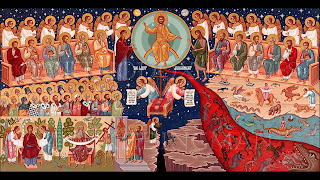
St. Augustin describes how generous our Lord is in offering us eternal rewards in exchange for giving Him comparatively insignificant acts of kindness in the people of the poor, sick, and imprisoned.
He says, “And what have I received, and what do I repay? 'I was an hungred,' He says, 'and you gave Me meat;' and the rest. I received earth, I will give heaven; I received temporal things, I will restore eternal; I received bread, I will give life. Yea, we may even say thus, I have received bread, I will give Bread; I have received drink, I will give Drink; I have received houseroom, I will give a House; I was visited in sickness, I will give Health; I was visited in prison, I will give Liberty. The bread which you gave to My poor is consumed; the Bread which I will give both recruits the failing and does not fail. May He then give us Bread, He who is the living Bread which came down from heaven. When He shall give Bread, He will give Himself. For what did you intend when you lent on usury? To give money, and to receive money; but to give a smaller sum, and to receive a larger. I, says God, will give you an exchange for the better for all that you have given Me. For if you were to give a pound of silver, and to receive a pound of gold, with how great joy would you be possessed? Examine and question avarice. I have given a pound of silver; I receive a pound of gold! What proportion is there between silver and gold! Much more then, what proportion is there between earth and heaven! And your silver and gold you were to leave here below; whereas you will not abide yourself for ever here. And I will give you something else, and I will give you something more, and I will give you something better; I will give you even that which will last forever. So then, Brethren, be our avarice restrained, that another, which is holy, may be enkindled. Evil altogether is her counsel, who hinders you from doing good. You are willing to serve an evil mistress, not owning a Good Lord. And sometimes two mistresses occupy the heart, and tear the slave asunder who deserves to be in slavery to such a double yoke. Yes, sometimes two opposing mistresses have possession of a man, avarice and luxuriousness. Avarice says, ‘Keep;’ luxuriousness, says, ‘Spend.’ Under two mistresses bidding and exacting diverse things what can you do?”
He then warns about how these two sins hinder us from trusting in our Lord and receiving heavenly rewards for earthly deposits.
Avarice tells us to “keep for yourself, consult for the future.” When we look at examples of people that have tried to preserve their wealth until a good old age or as a possession to pass on to their children, we see how most times things do not go as planned due to unexpected misfortunes or ungrateful children that are not benefited from such inheritances.
Our Lord wisely offers the same counsel as Avarice that we should “keep for ourselves and consult for our future.” We must keep for ourselves treasures in Heaven and consult for our future by preparing for eternity by being worthy of entering into the Kingdom of Heaven.
Luxuriousness tells us, “Do well to thine own soul, spend as freely as you can.” Our Lord shared the accounts of the rich man that spurned the beggar Lazarus and the rich man that wanted to build larger barns to show us the results of those that chose to only do well to their own souls. Both men had terrible ends in torments, both men having had their rewards in their earthly lives.
Our Lord once again uses the same words, but with different meaning saying, “Do well to thine own soul, spend as freely as you can” We do so by almsgiving, knowing that our reward will be in the Heavens that will last for eternity.
We are blessed to live in a time after our Lord’s Resurrection and after so many Saints of the Church to have been instructed and given Grace to do God’s will.
Unfortunately, our Lord has prophesied that even with these great advantages, evil will one day reach a height that people will worship and obey the Antichrist. This will bring about the second coming of Christ when He will come with great power to “cut off the incurable from the healthy like rotting limbs and deliver them into the fire, but His own He will rescue from the spiteful abuse of evil men and from contact with them, and will make them heirs of the kingdom of Heaven.” (Gregory Palamas)
So let us not be afraid to give of ourselves in fear of becoming poor, for we will hear Christ say to us, “Come, ye blessed of my Father, inherit the kingdom.” Rather let us be afraid of not showing love to God by our lack of compassion and hear the dreadful sentence of condemnation.
If we focus on what rich blessings our patient, loving Lord gives us in exchange for such small temporary acts of love, we will be strengthened and inspired to “attain this by the grace and love for mankind of our Lord Jesus Christ, to whom, together with the Father and the Holy Spirit, be honor and glory unto the ages of ages. Amen.” (Gregory Palamas)
Sunday, February 6, 2022
Zacchaeus Sunday (Luke 19:1-10)

And Jesus entered and passed through Jericho. And, behold, there was a man named Zacchaeus, which was the chief among the publicans, and he was rich. And he sought to see Jesus who he was; and could not for the press, because he was little of stature. And he ran before, and climbed up into a sycamore tree to see him: for he was to pass that way. And when Jesus came to the place, he looked up, and saw him, and said unto him, Zacchaeus, make haste, and come down; for today I must abide at thy house. And he made haste, and came down, and received him joyfully. And when they saw it, they all murmured, saying, that he was gone to be guest with a man that is a sinner. And Zacchaeus stood, and said unto the Lord: Behold, Lord, the half of my goods I give to the poor; and if I have taken anything from any man by false accusation, I restore him fourfold. And Jesus said unto him, this day is salvation come to this house, forsomuch as he also is a son of Abraham. For the Son of man is come to seek and to save that which was lost.
Last week we read of the healing of the blind man Bartimaeus, where our Lord rewarded the persistence of the blind man who continued to cry out to Jesus for mercy as the crowds tried to silence him. We can personally apply the events to ourselves as we too are blind spiritually, and when our Lord passes us by in His loving grace that He bestows on each person in His own way, desiring that all be saved, our remembrances of past wickedness try to silence our cry for our Lord to visit and heal us. If we persist in prayer God will call us unto Himself and heal us.
Today we read of the account of Zacchaeus and learn another way in which we all suffer spiritually but are able to be healed by our all-mighty God. We see that Zacchaeus was chief among the tax-collectors, of whom we know were of the most greedy and cold-hearted people of the day, making their fortune on taxing the poor unfairly.
We do likewise spiritually, using others primarily for selfish reasons and always looking for our own comfort with little regard for others. We share in the sins of our forefathers who greedily desired to be like God, ungrateful for all the gifts of God. We sell our birthright of being made in the image and likeness of God by not fearing God and his commandments, but rather committing gross sin for our own fleshly benefit. Our God-given conscience informs us that we are truly chief among sinners, as we admit in our prayers that we recite before partaking of the precious Body and Blood of our Lord.
But as our Lord wanted to demonstrate that no one is beyond forgiveness, and rescued Zacchaeus from the hold of Satan, we can have hope that our sins are not beyond forgiveness and that our Lord is willing to abide in us even though we have defiled ourselves and are not worthy for Him to enter into the temple of our bodies.
As our Lord was passing through Jericho, Zacchaeus, having heard of the miracles that Christ had performed, desired to see Him, indicating Zacchaeus’ unhappiness with the lifestyle of chief tax-collector. Using the gifts of conscience and the Mosaic Law, Zacchaeus was able to begin the process of repentance and climb up off of the earth and begin to ascend toward holier things, realizing that earthly and fleshly passions and sins were not allowing him to see our Lord.
Our Lord has lovingly given us all what is necessary to begin the journey toward salvation, but as is being taught in this account, it is Christ who comes to us to save us, as we are not capable of ascending into Heaven ourselves, even if we have begun to leave the cares of the world and climbed up toward a holier way of life.
Our Lord then tells Zacchaeus to quickly come down from the tree so that He could visit Zacchaeus in his home. The Gospel that our Lord taught and that the Church continues to teach is the Cross of Jesus Christ. The Word of God came down from Heaven and took the form of a slave by becoming the God-Man. Fulfilling all that God commanded of man and conquering death in Himself by voluntarily dying on the Cross and rising on the third day because death had no right to claim Him, for He had no sin. He then offered to us all a sharing in His victory, by Baptism into His death so that we could also share in His Resurrection. But just as He perfectly modeled humility and love for God and man, we are commanded to be perfect as well, which for us means dying to the old man and renewing our mind. Only then can we share in our Lord’s death, which perfectly modeled all the virtues of holiness.
So, as we begin our journey toward holiness by climbing the spiritual sycamore tree, our Lord meets us and offers us to descend into the earth with Him, calling us to humble ourselves and to die to our old way of life, by being baptized. Our Lord then longs to enter into our homes and dine with us. He offers us His Body and Blood in the Holy Mystery of the Eucharist.
After our Lord visited Zacchaeus in his home, he was moved to perform works worthy of repentance. This close encounter with our Lord gave him the ability to perfectly sacrifice everything in imitation of our Lord who sacrificed everything for us. He gave half of his money to the poor and paid back those that he had cheated fourfold with the rest of his money, leaving practically nothing for himself.
We see though that everyone that witnessed this visitation of our Lord to Zacchaeus was scandalized that Jesus would enter into the home of such a great sinner. This is a warning to us all that we must first of all never forget that we are the chief of sinners ourselves and not to judge others as sinners unworthy of Christ’s visitation. Secondly, it can teach us that no sin is too great for our Lord to heal and therefore we must look at each person we encounter with the hope that they will rise above their sinfulness and allow the Lord to invite them to die with Him to rise with Him and to enter into their home and become a member of the Holy Body of Christ.
Our Lord speaks of the communion of the Saints by calling Zacchaeus a son of Abraham. Abraham left everything behind and journeyed through the wilderness when God called him to do so. He also was willing to offer his only beloved son as a sacrifice when God instructed him to do so. Similarly, when we sacrifice everything to God and follow his commands, we are united with Abraham and all the other Saints and Angels who also sacrificed everything for our Lord’s sake.
Our Lord clearly states that He has come to seek and to save those that are lost. Only those that listen to the gentle counsels of God and begin the journey to rediscover the image and likeness of God that we have buried under layers of earthliness, can say that they are lost in this world, and that their real home is in the Heavens. Those that love sin and darkness cannot be said to be lost, because they are at home in this fallen world.
As we draw close to the great fast, let us remember our baptismal promises and plan to enter into the fast with a renewed zeal like little Zacchaeus, running and climbing up the sycamore tree, knowing that our Lord will come and strengthen us to descend with Him and sacrifice ourselves even more. Then we will have a joyous Pascha and will feel closer to our Lord, to the Holy Theotokos, and all the Angels and Saints. Amen.
Sunday, January 30, 2022
The healing of the blind man (Luke 18:35-43)

And it came to pass, that as he was come nigh unto Jericho, a certain blind man sat by the way side begging: And hearing the multitude pass by, he asked what it meant. And they told him, that Jesus of Nazareth passeth by. And he cried, saying, Jesus, thou son of David, have mercy on me. And they which went before rebuked him, that he should hold his peace: but he cried so much the more, thou son of David, have mercy on me. And Jesus stood, and commanded him to be brought unto him: and when he was come near, he asked him, Saying, what wilt thou that I shall do unto thee? And he said, Lord, that I may receive my sight. And Jesus said unto him, receive thy sight: thy faith hath saved thee. And immediately he received his sight, and followed him, glorifying God: and all the people, when they saw it, gave praise unto God.
Why does God allow people to be born blind? How can the person born blind deserve to be deprived of his sight if he has not yet committed any sin worthy of punishment? We may be tempted to accuse God of a great injustice especially if this type of ailment affects someone close to us, like a child. But we must remember that temporary physical blindness is but a second of unpleasantness in the potential eternal blessedness of the glory of Communion with God in Heaven. It is just how as tasting a bitter medicine for a moment causes us agony, but heals us of a serious ailment.
Our Lord only allows physical blindness in this fallen world to be a symbol of the spiritual blindness that all mankind possesses to some degree. When our first parents sinned against God they were driven away from the light and suffered the darkness of condemnation.
But as we hear in today’s Gospel reading, our Lord Jesus Christ drew near to the city of Jericho. Jericho is interpreted as ‘moon’, and so we can understand this event to be describing the condescension of our Lord in assuming a human body to recover the light that it had lost, as the moon depicts the weakness of our mortal nature by waning in its monthly changes. As our Lord suffered as a human, humans are raised up to divinity.
As we hear the blind man call out to Christ to have mercy on him, we see that those that went before Christ told the blind man to be quiet. We understand this event to symbolize the spiritually blind longing for the light of truth, but as they cry to the Lord the crowds of bodily desires and the uproar caused by our vices try to silence or prayer to God.
As we pray to God to come and deliver us from darkness and lead us into light, images of our sins come into our hearts and obscure our inner vision, sometimes rising up in our thoughts as images to throw us into confusion in the very act of praying.
We are being instructed to imitate the blind man when such assailments come our way, and to cry out even more fervently to our Lord to have mercy on us since we are weak and unable to fight against the crowds of temptations that remind us of our sins. Even if we are remorseful for our sins, the sorrows of repentance hardly drive away the images of past sins.
Then we hear that our Lord stopped and ordered the blind man to be brought to Him. The two natures of Christ are emphasized here. In our Lords humanity which can be described as changing and moving, our Lord has become close to us and attracted us towards Himself. Once this has occurred, our Lord calls us to Himself as He stands still in His Divinity and gives us His Light that heals us from our blindness.
When Christ called the blind man to Himself, He asked him what he wanted, and the blind man requested only that he would be given his sight. We must imitate him and not ask for deceptive riches or earthly gifts or passing honors, but only for Light.
Then after healing the blind man, our Lord credits the man’s faith in his being healed of his blindness, emphasizing our part in responding to our Lords grace with our free will. He is not ashamed to give all the credit to the blind man although it is in reality only by His great mercy that the blind man even had the opportunity to be healed. Our Lord loves all mankind and desires that all be saved and offers great mercy to all. Only some respond to this call with the desire to receive spiritual sight and that is why our Lord credits those that faithfully beg our Lord for sight for being healed by their faith.
Then the man who was previously blind follows after our Lord. This means nothing else than imitating our Lord who left an example of how to live. “He refused to prosper in this world; he endured reproaches and mockery, he bore up under spitting, scourging, blows, a crown of thorns and a cross. Because we had fallen away from inner joy by our delight in material things, He showed with what bitterness we must return to it.”-Gregory the Great
And as this man was healed by his repentance and perseverance and by imitating Christ, others gave glory to God and also entered into the process of being healed of spiritual blindness. May we continue on our path in seeking God’s Light, healing us of all darkness by our constant prayer to our Lord, His most pure Mother, the Bodiless Hosts, and all the Saints. Then we too may attract others to abandon the darkness and draw close to God and be healed. Amen.
Sunday, January 16, 2022
St. John the Forerunner of Christ (Mark 1:1-8)

As we prepare to celebrate the Theophany of the Lord, when Jesus Christ was baptized in the Jordan by St. John the Forerunner, we read today of the work of St. John to prepare the Jewish people for the coming of our Lord. These people had been blessed by God to have the prophets that not only gave an example of a holy way of life, but also warned and instructed the Jewish people about God’s commandments and punishments for disobedience.
Sadly, with this great privilege, many did not appreciate it and even began to boast in the privilege of simply being born as sons of Abraham. We as Christians often are tempted to do the same. We sometimes claim all of the blessings of Christians simply because we have been baptized and attend Church, forgetting that to truly benefit from membership in the Church, we must apply what we have been given in our daily lives by constantly growing in humility and love.
As our Lord was preparing to begin his public ministry, He had St. John begin to get the Jewish people ready to accept the teachings of Christ. He was about to teach deeper truths that were only understood in shadows by the Law of Moses, and did not want to scandalize anyone, so he had the greatest follower of the Law begin to baptize in a similar way that Christ would require.
St. John began to teach deeper truths leading to the Gospel of Jesus Christ. He leveled the mountains and valleys, making straight paths in the souls of people by teaching the need for humility. Those that exalt themselves will be brought down by God and those that lower themselves before God and man will be rewarded and brought up high by God. It was by thinking too much of ourselves that we fell in the garden of Eden, and only by recognizing our lowliness will we be granted access to it again.
We have all been born into this fallen world, we have all sinned and have exalted ourselves high in our pride. It is needed that we repent of this and confess our sin to God. St. John instructed the Jewish people of this need and promised them that soon the Promised One, the Bridegroom to the faithful would come and actually grant forgiveness of the sins of pride that have kept us from Paradise.
We see that St. John was clothed in camel’s hair and wore a leather girdle of skin around his loins, showing the need to live a life of asceticism in wearing poor, uncomfortable clothes that help us fight against the sins of vanity and of pleasure seeking, and wearing a dead animal about or loins to represent a chaste life of dying to the beastly sexual impulses that create so many injuries to the souls of mankind.
We are told that he only ate locusts and wild honey while living in the wilderness. St. Bede describes the symbolism of these two items by saying that “On account of their short flight, locusts suggest the Jewish nation’s vacillating mind, by which they were borne up and down between the Lord and idols. The wild honey signifies the sweetness of the natural wisdom by which the uncultivated people of foreign countries were refreshed. And when from both peoples the Lord chose those whom he would bring by his teaching into the unity of his body, which is the Church, they were undoubtedly being fed upon locusts and wild honey, because he turned many into his members, both from the one people, who sought heavenly things with a wavering intention, and from the other nation, who knew only the taste of earthly philosophy.”
Next, we are told that St. John did not feel worthy to unloose our Lord’s shoe. St. Bede once again provides a very good explanation of the seemingly odd choice of words. He reminds us of the Jewish tradition of a brother being responsible for marrying a deceased brother’s wife if she had not yet borne a child. The next brother in line was only allowed to forgo this by the ritual of taking off a shoe and handing it to another that would take the widow as wife. So, St. John was indicating that he was not the Messiah and bridegroom by stating that to do so would be to take off the shoe of Christ who was the rightful next of kin to marry the bride. Our Lord being the second Adam rightfully has wedded the Church to Himself to pick up were Adam failed and He has brought forth spiritual children by her, the saints who live in Communion with the Holy Trinity.
And so, although St. John’s baptism was only in water and our Lord baptizes with the Holy Ghost, it was still needful that he prepare for the outpouring of God’s grace with human effort. The Sacraments of the Church work similarly; we offer to God our human effort and physical forms, in bread, wine, oil, and water, and God only then pours out the gifts of the Holy Spirit. Our Lord was teaching us the synergy needed for our salvation.
May we come to Christ’s Church and lower ourselves from our prideful way of life and be leveled. And repenting and confessing our prideful sins, may we bring forth fruits worthy of repentance, so that we may be granted access back to the Tree of Life only offered to those lowly of spirit, and be made communicants of our Lord Jesus Christ, to whom be the Glory with the Father and the Holy Spirit, now and ever and unto the ages of ages, Amen.
Sunday, December 19, 2021
The Healing of the Ten Lepers (Luke 17:12-19)

In today’s Gospel reading we hear of the healing of ten lepers. It is easy to pass by this account without noticing some very important lessons that explain our spiritual condition and how we are able to be healed of our spiritual infirmities.
We can think back to the garden of Eden and recall how our first parents, surrounded by unlimited delight and enjoying perfect health failed to be grateful for these gifts by pondering on the venomous words of the Devil and eventually believing them, that God was withholding something from them that would truly make them happy. Only once cast out of Eden did our first mother begin to thank God for all that He provided for her, when after giving birth to her first son Cain, she said, “I have acquired a man through God.” Sadly, we usually are not able to cherish anything until it is gone. When things go well, we take them for granted. And so, we might sometimes wonder why it is that God at times instructs us to pray constantly, and at other times makes it clear that before we pray, He already knows what we need. In today’s gospel reading we see our Lord asking, “were there not ten cleansed, but where are the nine? There are not found that returned to give glory to God, save this stranger?” This question from our Lord is similar to His question in the Garden to Adam once he had transgressed, when He asked, “Adam, where art thou?” Our Lord does not ask these questions to find anything out for He knows all things. In both cases, He was lowering Himself to help us come to the right understanding of our sinfulness and the need to ask for forgiveness and once it is given to be thankful for it. So, from this it is abundantly clear that God does not need our prayers, but rather we need them as they help us to remember our sinfulness and they help us to never become ungrateful for all of God’s great gifts and acts of mercy.
We also notice that our Lord told the lepers to go show themselves to the priests. Jesus was making clear that He was not against the Mosaic Law. We do not believe that God instituted these things for no reason, but rather believe they foreshadowed the Christian priesthood that He would establish. Sadly, many reject the Christian priesthood, making it appear as if our Lord made a mistake by having a priesthood in the Old Testament. As Orthodox Christians however, we continue the tradition of going to the priests to be declared healed of the “leprosy” of sins in the Mystery of Confession. And just as how the Jews were instructed to not even go near a man with leprosy, we see that we are not to keep company with sinful people.
Lastly, we should notice how our Lord gave the credit of the leper’s healing to the leper saying, “thy faith hath made thee whole,” showing us how we should give credit as much as possible to others and not take credit for ourselves. Our Lord had all the right to show that it was He Himself that was responsible for the healing of the lepers, but since He cares nothing for pride, but only wills to share His dignity with us ungrateful humans, declares that it was the leper’s faith that healed him. The infinitely smaller portion that we contribute is viewed by God as so important that He is willing to give it all of the credit. We need to imitate our Lord and not speak of how much we do, but how much we are indebted to God and our fellow man for everything good in our lives.
May we learn from the Samaritan leper from what great illness we have been delivered and continuously give thanks to our Lord until the day we finally enter into the heavenly mansions that we will never take for granted again. Amen.
Sunday, November 7, 2021
Lazarus and the Rich Man – Luke 16:19-31

Our Lord has taught us the purest form of Holiness with regard to the use of our riches in His instructions earlier given where He said, “Sell that ye have, and give alms; provide yourselves bags which wax not old, a treasure in the heavens that faileth not, where no thief approacheth, neither moth corrupteth.” Later he also told the rich young ruler how to be perfect saying, “sell all that thou hast, and distribute unto the poor, and thou shalt have treasure in heaven: and come, follow me.”
But our Lord is merciful and desires our salvation more than we do ourselves and has provided a lesser way in which we can still learn and be granted access to Heaven. He teaches us saying, “And I say unto you, Make to yourselves friends of the mammon of unrighteousness; that, when ye fail, they may receive you into everlasting habitations.” Those that cannot fully abandon money altogether are told to distribute it to those in need and when it fails us as we leave this life, we will be received into the everlasting habitations of Heaven for having taken care of the poor.
In today’s gospel reading we hear of the parable of Lazarus and the rich man. We are shown the drastic difference between one who was so wealthy and took no notice of the need to care for the poor and someone so poor and sickly that he could not take care of himself, much less offer anything to the poor. In one way we could say that God unequally lends possessions to men. This is done to teach man that we depend on each other and to make wise use of what God has lent us, working towards both our own salvation and that of our brethren.
But in another way, we would say that God has equally bestowed possessions among mankind because with each person’s amount of possessions, different temptations are made. Those with less possession struggle with temptations like despair and sadness, while those with many possessions struggle with almsgiving, gluttony, pride, and a plethora of sins.
What is seen by the physical eye is many times not what is true of the spiritual reality. In the parable we see a rich man in costly apparel that actually physically represents the spiritual reality of Lazarus because he was spiritually rich because he had learned the truth of the vanity of transient riches and become humble enough to desire only crumbs that had fallen to the floor, not seeing himself as deserving of great honor as many of us do.
On the other hand, we see Lazarus, poor and sick and starving to death. He physically represents the spiritual condition of the rich man. He was lacking the basic decency of not feeling sorry for Lazarus and providing him even the minimal help of giving him his leftovers from his daily feasts. The passage does not even add other sins to this because it is clear that if he was lacking in this area, many other sins abounded in him.
What can we learn from this story other than the basic teaching to not neglect the poor? If we look closely to the description of the rich man, we can glean a few other lessons. First, we see that the rich man was clothed in purple and fine linen. This is no mere trivial description. St. Gregory the Great teaches that this description proves the sinfulness of acquiring costly clothing saying, “No one looks for remarkable clothes except out of vainglory, to appear more worthy of respect than others. That no one puts on expensive clothing where he cannot be seen by others testifies that costly clothing is only sought out of vainglory.” He then makes note that the Holy Saint, John the Baptist is described wearing cheap clothing to prove that wearing cheap clothes is virtuous.
Next, we see that the rich man fared sumptuously every day. We are tempted to find pleasure in entertainment every day. But we must remember that we are not to have hearts that are only aroused to merriment by musicians and dancers, but that our hearts must be filled with joy and merriment by God as the Psalmist says, “My heart and my flesh rejoice in the living God” (Psalm 84:2)
As we see the judgment of the Rich man and Lazarus, we see the reversal of the joy and suffering experienced by the two men. The rich man is now like Lazarus that only wanted crumbs, asking for a drop of water. We are warned about the torment that awaits those in Hell.
Many are deceived into thinking that Jesus has lightened the strictness that God required of His people as laid out in the Old Testament. But as seen in this parable and in many of our Lord’s teachings, much more is required of Christians than was required of the Jews. Then he only commanded to not steal, now by not giving of what is legally yours, you will be condemned.
We might wonder why the rich man seems to be concerned with his 5 brothers, when he seems to be an evil man. It’s possible that he is making the excuse that he was not warned enough about the need to give alms and is using his concern for his brothers as a way to justify himself. It is also possible that part of the torments he was experiencing were due to his influence on his younger brothers. If he was able to warn them, his torments could be reduced. It could also just be that although he still had love for his own family members, he was not found worthy of entrance into Heavenly life, much like the commandment to love our enemies. We are told that even sinners love those that love them.
Allegorically, we can look at this rich man as those who have been given so much abundance in the knowledge of God through the Church but instead of being a source of Love, it became a source of pride. The poor beggar, Lazarus, symbolizes those around us that we fail to even give even the crumbs of the faith that we have squandered.
In these trying times in which man is in desperate need of God’s Love, may we find ways to share with those starving and covered in sores the banquet we have been blessed to have access to in the Sacraments of the Church. We cannot keep these things to ourselves just as we cannot hoard our physical possessions. We will all have to account for how we shared what God has graciously given each of us. May we be found worthy of joining the ranks of our Father Abraham who although was materially wealthy, is not described as rich, because his virtue was greater than his wealth, being known for his hospitality to strangers in which he cared for angels that represented the Holy Trinity, to whom be the glory, honor, and worship, of the Father, and of the Son, and of the Holy Spirit. Amen.
Sunday, October 3, 2021
Matthew 22:35-46: The Greatest Commandment and the Two Natures of Christ

In today’s Gospel reading, we hear of a lawyer testing our Lord to see if He would contradict or add to the law of Moses. He asks what is the greatest commandment. We are blessed to hear how all of the commandments are really summed up into two commandments, to love God and to love our neighbor, and that even these two are really combined into one commandment because one cannot truly be done without the other. We are reminded of our Lord asking Peter if he loved Him, and then asking him to feed His sheep, and of the inspection at our Lord’s second coming where He will either commend or condemn us for seeing Him hungry and feeding him or not in the people we encounter.
The very man that came originally to catch our Lord in blasphemy was so amazed at the Wisdom of God that he responded to Jesus with a clear understanding of the importance of loving God and neighbor more than fulfilling the burnt offerings and sacrifices required by the Law, because these practices could easily be done out of obligation and not out of Love. In the parallel account in Mark, Jesus tells the man that he is not far from the Kingdom of God, showing that although he did not perfectly understand who Christ was, he was beginning to open himself up to accepting our Lord in the flesh.
Our Lord was very patient in revealing His Divinity because He knew that it would be very difficult to accept it if He appeared to be setting Himself up in some form of opposition to God the Father. He allowed the crowds to think less of Him and to continue speaking of God as being One, although in reality God is really three, because in a few very important ways, God is One. He is one in essence, and more importantly He is One in opposition to thinking there are really other gods in the idols created by men and the demons.
He then led them to further understanding of His Divinity by asking what they thought of Christ; who’s son is He? They reveal their misunderstanding of the prophecy by saying that He is merely the son of David. He shows them how it is said that David calls the Christ Lord, although He is also his son. He is showing how both are realities, He is the son of David, but is also Lord, being of the same essence of God the Father and therefore equal in honor to Him. The Church’s teaching of the two natures of Christ are clearly shown in this prophecy and in our Lord’s use of this prophecy in His teaching.
After our Lord clearly explained how the Law taught the Divinity of Christ, all understood and could no longer use blasphemy against Him until He was arrested and condemned. At that point they were coming up with false charges to put Him to death because He brought Light to their darkness.
Sadly, there are many good-hearted Jehovah’s witnesses that have been so far removed from the Church that they have gone back to the understanding that Christ is merely the son of David and not Lord in the sense of being of one essence and equal in honor with God the Father. There are great dangers in reading the Holy Scriptures with an independent attitude and not with the guidance of the Church’s interpretation. God knew there would be this possibility and has allowed it to show us the harm of developing an independent spirit and not having the virtue of obedience to His bride and protector of the Faith, His Church.
May we humble ourselves and beg God to show us through the Holy Saints how to understand His Holy Word that gives us Life. Amen.
Sunday, September 26, 2021
Matthew 22:1-14 The Invitation to the Marriage Feast of the King's Son

Today’s Gospel reading is a very sobering reminder of the need to respond to our Lord’s invitation by putting on the wedding garment of the virtues and not ignoring or even hating our Lord’s call to holiness.
Many unrighteous people hear about this call to holiness and find fault with our Creator asking, “why did He create people who He knew were going to be damned?”
To answer the question, we must recognize that without the possibility of doing evil, man would not be rational. Reason without free choice or self-governance would be pointless. Man could be neither good or evil.
So, in demanding that God should not have made those that will be punished, one also is saying that He should not have made those that will be saved or any rational and free beings at all. And since the creation was made for the sake of mankind, they are saying that God should not have created anything at all.
What was God to do then? Should He have not made men that would be good on account of those who would turn out evil? St. Gregory Palamas answers, “That would be the greatest injustice imaginable. For even if there were only going to be one good person, it would not have been just to stop creating, since one man who does God’s will is superior to innumerable sinners.”
And it is not as if God does not invite all to become holy and provide the loving means to do so for each person.
In the parable we hear about a marriage for the King’s Son. This is the union of the Son of God with man’s nature, and hence with the Church. And the Greek uses the plural for nuptials or festivities because whenever Christ, the bridegroom of pure souls, is mystically united with each soul, He gives the Father occasion to rejoice over this as at a wedding.
We see in the parable the rejection of the invitation by the Jews and the calling in of the Gentiles. But both good and bad are brought in, and then an inspection is done by the King.
Then we hear the haunting words of God, “Friend, how camest thou in hither not having a wedding garment? And he was speechless. Then said the king to the servants, bind him hand and foot, and take him away, and cast him into outer darkness, there shall be weeping and gnashing of teeth.”
The evil man is called friend on behalf of his faith, but is condemned on behalf of his sinfulness and lack of virtue and good deeds. The garment we have at inspection will be how we used our time in this life acquiring the virtues of self-control, purity and chastity, compassion, humility, and modesty and meekness.
The very hands and feet of the wicked that are now shackled by their sins, will be bound for all eternity and cast into outer darkness, going even further away from God.
May we use our feet and hands to do good works and run to the service of God and our fellow man so that at the last judgment we will have put on a beautiful wedding garment and can enjoy the marriage feast of the righteous with our Lord Jesus Christ, to whom be the glory and honor, with the Father and the Holy Spirit, now and ever and unto the ages of ages. Amen.
Sunday, August 22, 2021
Christ walking on the water and about temptations (Matthew 14:22-34)

As Christianity has become more watered down over the ages due to the lack of persecution that has lulled Christians into a sort of sleep, we have begun to view things as the world does and not as Christ has shown us. One of the clearest examples is our view of trials or temptations in the form of suffering.
Many Christians today wonder why, when they have been faithful to God and have striven to obey God’s commandments, it is that they seem to suffer more than those that have denied God and make no effort to obey His commandments.
While it is natural to expect God’s favor after striving to follow His commandments, we seem to have lost the foundational view of this current life in this fallen world. We have become confused and have fallen for the delusion that the enemy constantly presents to us to lose sight of the realities that Christ has shown us, namely exchanging eternal life in Heaven for temporal pleasure on this fallen world.
Our Lord did not teach a health and wealth Gospel. The health and wealth that Christians receive is invisible to the fleshly eye and only seen by those who also love God and holy things. To the fleshly eye, we look pitiable and weak, but to the eye that sees clearly, Christians are seen to be strong and rich, having an inheritance in the Heavens.
Just as an athlete is only able to obtain the highest achievements through rigorous training, so likewise is a Christian able to reach perfection only through the training of temptations. For those whose faith has already reached a level of perfection, temptations help to demonstrate their perfection. And for those that are still imperfect, temptations provide a method for their becoming perfect.
Today’s Gospel reading is an example of the latter. We read about the Apostles being tempted by the wind and sea while aboard a ship.
Wanting to train His Apostles in patience and being able to bear hardship, our Lord allowed them to be tempted on the dangerous sea for a long time and even allowed them to think He was a ghost before giving the calming words of salvation, His declaration of His divinity, calling Himself, “I am”, the title of God, the creator and controller of all things, including the boisterous sea.
St. John Chrysostom explains why it was that Jesus allowed them to be tempted so hard saying, “He lets them be tempest-tossed all the night, thoroughly to awaken, as I suppose, their hardened heart. And together with the compunction, He cast them also into a greater longing for Himself, and a continual remembrance of Him. Accordingly, neither did He present Himself to them at once. For, “in the fourth watch,” so it is said, “of the night, He went unto them, walking upon the sea;” instructing them not hastily to seek for deliverance from their pressing dangers, but to bear all occurrences manfully.”
Our Lord taught his Apostles in stages. Earlier He had calmed the seas while aboard a ship with them. Now that they had learned more and developed a stronger faith, He does not stop the storm, but demonstrates His power over the temptation by walking on it and showing that He can also give the ability to walk on the water to those with faith.
This account can be symbolically interpreted to represent our situation. Jesus had just healed, taught, and fed the crowds in a miraculous way and went up the mountain and sent his disciples to cross over the stormy sea. Likewise, our Lord has brought healing, wisdom, and spiritual sustenance through His Incarnation and His Ascension into the Heavens as our Mediator, and has sent us to cross over this stormy life by which we are tempted to produce and show our faith.
Just as the Lord did not calm the sea, but gave Peter the ability to walk on it, in our life here in this fallen world, trials are not taken away from us, but we are given the ability to overcome them by our Lord if we only have faith in Him. Only when Christ returns in His second coming will He fully put an end to the terrible waves stirred up against His Church and trample them under foot.
There are also different types of temptations that we can speak of. Concerning these types of temptations that are being taught today, there are those of pleasure or pain, health or sickness, honor or dishonor, riches or poverty. And those considered more favorable to the world are actually the more harmful and dangerous.
But there are also different types of temptations in another sense. There are temptations that come from outside and those that come from within. These that we have spoken about and that God uses come from outside. The temptations that come from within come from sin and bring spiritual death, departure from God. These temptations do not come from God and we must flee these temptations. That is why we ask God to lead us not into temptation.
We have confused these types of temptations and ask God to shield us from the temptations that actually bring us eternal life and perfection and these other deadly temptations we overlook. If we cleanse ourselves from all iniquity by repenting, we will only need more moderate temptations here and will in the future return to the life free from sorrows and trials.
May we imitate our Lord who lowered Himself and was tempted in all ways like us except sin so that we too can share in His Ascension to the Heavens with those who have patiently awaited their reward for their endurance in temptation, to Whom be the glory and honor and worship, together with the Father and Holy Spirit. Amen.
Sunday, July 25, 2021
Matthew 8:28-9:1 The freeing of the demoniacs

First, we see that demons have the ability to possess men, making their victims worse than dead men. For at least the dead have their souls in the hands of God, while those possessed by demons have their souls and bodies enslaved by the demons. The healing of these possessed men is actually much greater than the miracles of Christ raising the dead.
We also learn that the demons are very strong and dangerous and desire the physical and spiritual death of all mankind. We learn from the parallel accounts in Mark and Luke that these demons caused the possessed men to cut themselves with rocks and caused them to strip themselves of clothing and dwell in the cemetery. They were able to beak the chains that were put on them by those that tried to restrain them and they forced those that lived nearby to avoid them out of fear for their lives.
They chose to live in the cemetery to trick the people into believing that the souls of the dead became demons, causing great confusion and leading people into sorcery.
By their action of destroying the multitude of swine, we see that they would quickly destroy all of mankind if they were given the ability to do so by God. We also see that even when they were cast out of these men, they desired to bring further misfortune to men by destroying the costly multitude of swine, with the desire that the pig herders curse God for this great financial loss.
Next, we learn about the great judgment and the torments of Hell. The demons immediately felt the torment that awaits them when our Lord confronted them, like the bright sun to weak eyes. They knew that they had a little while to continue in their filth and were grieved when it seemed that maybe the time had come for them to be cast into hell and to be deprived of tormenting man any longer. They, like many men confronted with death, out of torment and despair, tried to appeal to our Lord’s mercy by calling on Him as the Son of God.
We should learn from the demons who are aware of the torment to come, that this torment also awaits sinful men in no less measure. Unlike the demons, we have the choice to turn from our wicked ways and to be spared the torment prepared for the demons.
Lastly, we can speak about the spiritual lessons that apply to each of us. By God allowing the demons to enter into the swine, we learn that the demons desire to enter into those that are swine-like in their uncleanness and glutenous behavior. Our Lord wants to teach us how quickly we go to destruction, like the herd of swine, when we do not practice patience and fasting and do not strive to lead a pure life.
These demoniacs spiritually represent men addicted to all kinds of vices. Like the demoniacs that went about naked, these men, although clothed in garments, are deprived of the true covering, the glory of the image of God. And as they cut themselves with stones, these sinful men cut themselves with their sins. And as they haunted the tombs, these men cannot break free from frequenting places of sin which are more full of death than any cemetery.
And as they were able to break free from all types of restraints, these sinful men also do not listen to threats or counsel that would restrain their wickedness and free them from their sin.
And we also are very much like the city that saw the great works of our Lord and asked that He depart from us. We are given so many miracles and promises of spiritual healing in the Church and yet we still would rather enjoy the pleasures of this fallen world than take the narrow path to salvation that requires of us a stricter way of life. We would prefer the multitude of swine over being in our right mind.
It is not possible for us to be cured of these sicknesses on our own. So let us beg our Lord to give us the strength to turn from our passions and to follow after Christ, and like the freed demoniac, share with all the great things that our Lord has done for us, to Whom be the glory together with the Father and the Holy Spirit now and ever and unto the ages of ages, Amen.
Subscribe to:
Posts (Atom)